
St. Louis has plenty of unique quirks; we can drink alcohol in public places, passengers in moving vehicles can drink alcohol (called Roadie Soadie), we toast our ravioli, make French toast when it snows, drivers merge on and off highways by crossing multiple lanes in one quick move (blinker is optional), we demand jokes from trick-or-treaters, and old folks pronounce words like “fork” and “forty” as “fark” and “farty.” But to me, the strangest localized societal norm that I didn’t think twice about until I was a full-blown adult was the custom of keeping box turtles (Terrapene triunguis) in the basement as a form of pest control. If you peruse the St. Louis subreddit, you will see this topic come up from time to time, and in fact, there are even a few news articles regarding the practice that have been published over the last few years.
My Grandma Gerry had a few turtles in her basement that were brought into the house from the backyard when my mother was a kid, one of which was named ‘Myrtle.’ Surprisingly, after my Grandma Gerry passed away in 2021, one of the turtles was found to still be alive and was taken in by a family member. As children, my cousins and I would be tasked with bringing down vegetable and fruit scraps for the turtles, and when those were not available, she would have us give them dog food that we had to pour water on to “soften it for them.” The turtles were very friendly and would come out when they noticed you near their food and water dish.
My father’s parents also had a box turtle in their basement, named ‘Salt,’ who really enjoyed sliced white grapes, according to my dad. I promise this practice of utilizing box turtles for pest control wasn’t just my kin; I had friends whose parents and grandparents also had turtles in their basements. When I was a kid, my father brought home a box turtle in a cardboard box that he found tempting fate by trying to cross Kingshighway. Despite finding the turtle near Forest Park, we kept it, and I named him ‘Blades’ because, well, I was a ’90s kid, and I had Wild Berry Pop-Tarts coursing through my veins!
When we briefly lived in Washington Missouri, Blades had a new friend “join” who was named ‘Meeko’ after the raccoon from Pocahontas because I loved that movie as a kid. I played with those two turtles often as a child, and I remember taking them out in the yard to play from time to time. Eventually, my father moved to a house that had a finished basement, and he let the turtles go in his yard.
While we are already traveling down memory lane, I have one more story for you before we move on to the prestigious reptile who is Missouri’s official state reptile. One day, my cousins and I noticed while playing in my grandma’s basement that a turtle was more than likely dead. It was not moving and hadn’t left that spot for at least a few days after our discovering it. My Grandma Gerry, being who she was, didn’t believe us when we told her the turtle passed. She exclaimed that the turtle was merely “sleeping” and “old.” Boy, you should have seen the look of horror on all of our faces when she came down to prove us wrong and gave the turtle a scoot with her penny loafer-encased foot. The turtle shell moved alright, but the limbs fell out of the shell as the thing had clearly been dead longer than we realized. My cousin and I ran upstairs, trying to escape the scene, but obviously, the event left us shell shocked.
There are several theories online as to why St. Louisans took up this odd practice of housing turtles as pest control, but I am not sure there has been any definitive conclusion as to why it became so prevalent here. The basements here were traditionally unfinished; some were simply dirt, others, like my grandparents’, were slabs of concrete, but this is true throughout much of the country. Regardless of what started it all, the fad has, for the most part, come to an end, although there are a few stragglers who are still being kept in basements by mostly older generations. In fact, nowadays there are thankfully laws to protect these poor turtles from being locked away in the darkness to eat scraps and whatever bugs they may find.
And rightfully so, as you can imagine, it wouldn’t be fun to never see the light of day again, and the turtles that are kept this way tend to develop abnormally. Their top beaks will overgrow from not eating the right foods and eating on substrate, which helps to shave down the beak. Their nails will grow gnarly long from not having the proper terrain and ability to dig, which helps keep the nails the right length. And their shells can develop abnormally from a lack of the proper nutrients they need. As well, they do not develop a true sense of fear for predators and will eventually forget how to overwinter or live in their natural environment. Often, people who grow tired of them as pets or discover them in the basement of a recently departed loved one will simply let these turtles go in their backyard or in a park, and while this is done with great intentions, the turtles will most likely succumb to the elements when winter comes. And this is where ‘Shellington’ enters the stage, as well as our lives.
A few weekends ago, after my daughter’s track meet, ironically enough, we found a Three-Toed Box Turtle (Terrapene carolina triunguis) heading dangerously close to a storm drain on the crosswalk next to our yard. The children were extremely excited about seeing the turtle and begged for us to keep him as a pet. I guess the St. Louis blood runs deep with them, but I assured them this turtle will NOT be coming into our house as they are meant to live outside. We did, however, move the turtle into our yard to keep it from falling victim to the storm drain or the dogs that live in all the surrounding yards.
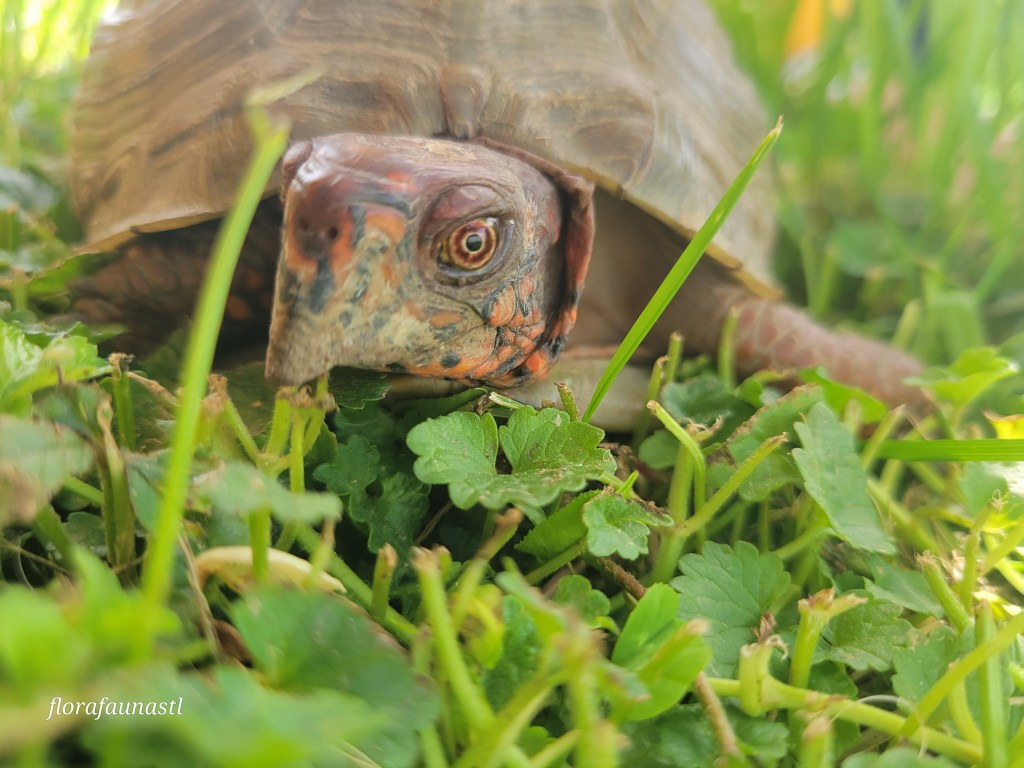

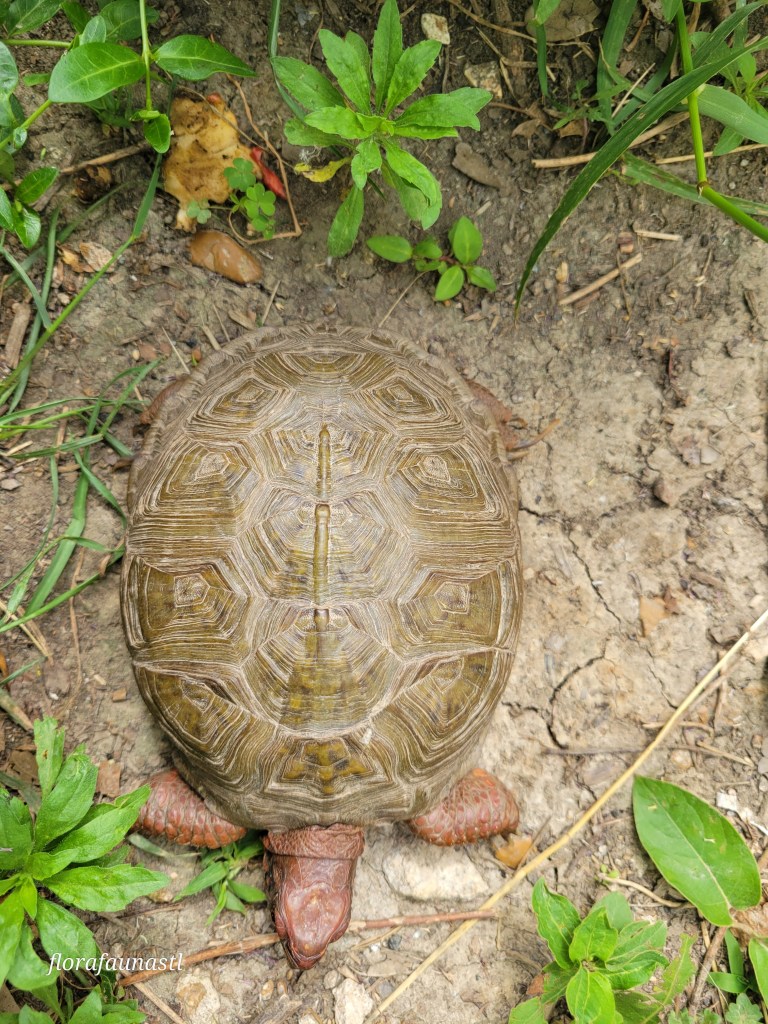
Three-Toed Box Turtles are found in the wild throughout most of Missouri, and their range nationally spans from Northern Missouri down to the upper panhandle of Florida, west to Eastern Texas, and east to the Carolinas, with some being found farther north on occasion. Three-Toed Box turtles are terrestrial turtles that tend to have only three toes on their back feet, although sometimes they will have four toes. Studies show that there is much more variation in the number of toes found on the different subspecies of Terrapene triunguis (which the Three-Toed Box Turtle is one of), so looking at back foot digits alone is not a great way of identification. Three-Toed Box Turtle shells (carapace) are typically lengths of about 5 inches but can get bigger and are an olive green color with yellowish-orange lines within the scute or scutum, which is the external plating that covers a turtle’s shell. The scute is made up of keratin, which is similar to our fingernails. There is usually a ridge that runs along the center of the Three-Toed turtles’ carapace. The bottom (ventral) part of a turtle shell is called the plastron, and Three-Toed Box Turtles have a single-lined hinge that runs along the front part of the plastron. This allows the turtle to close the bottom of its shell snugly against the top for protection from predators.
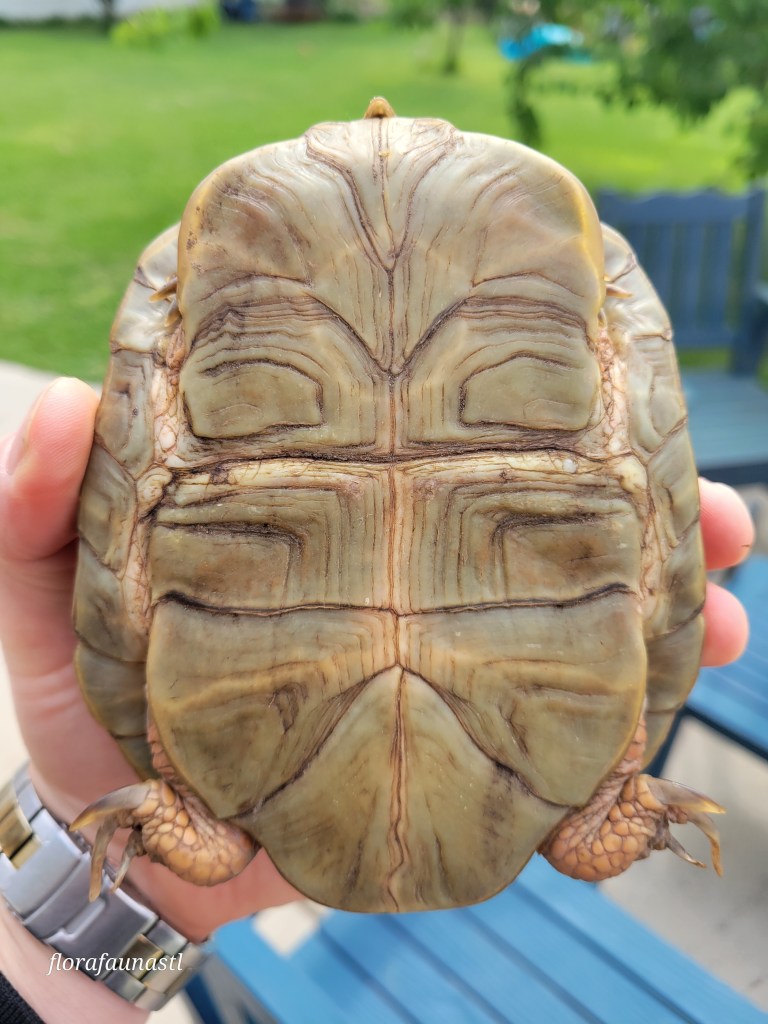
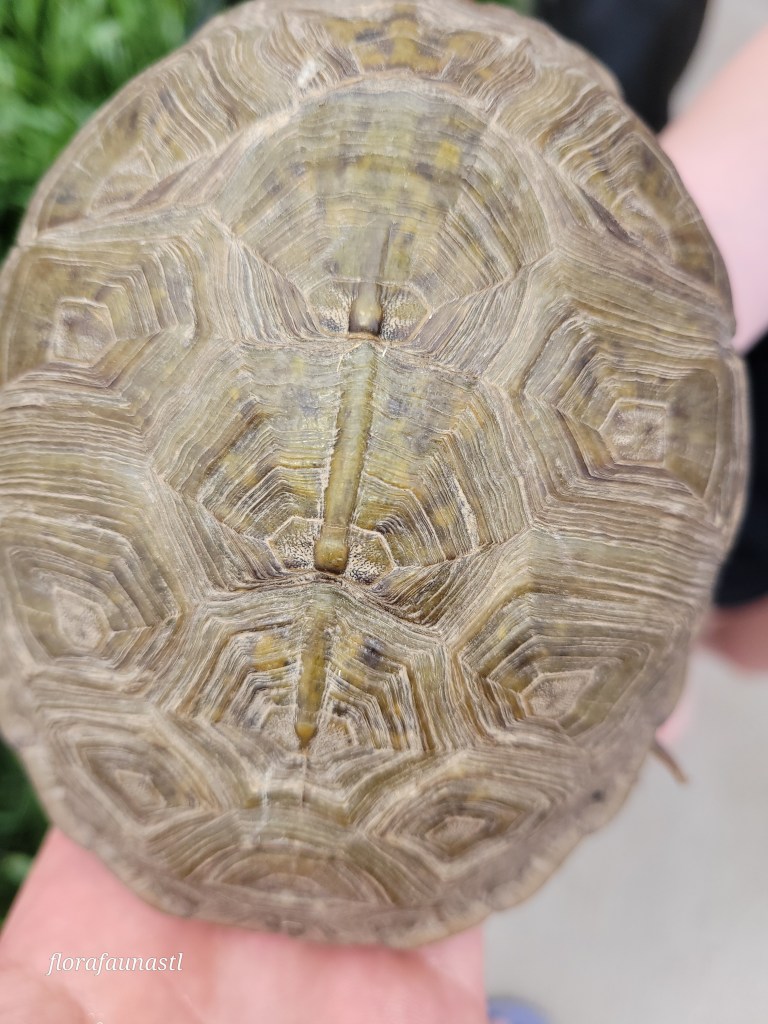
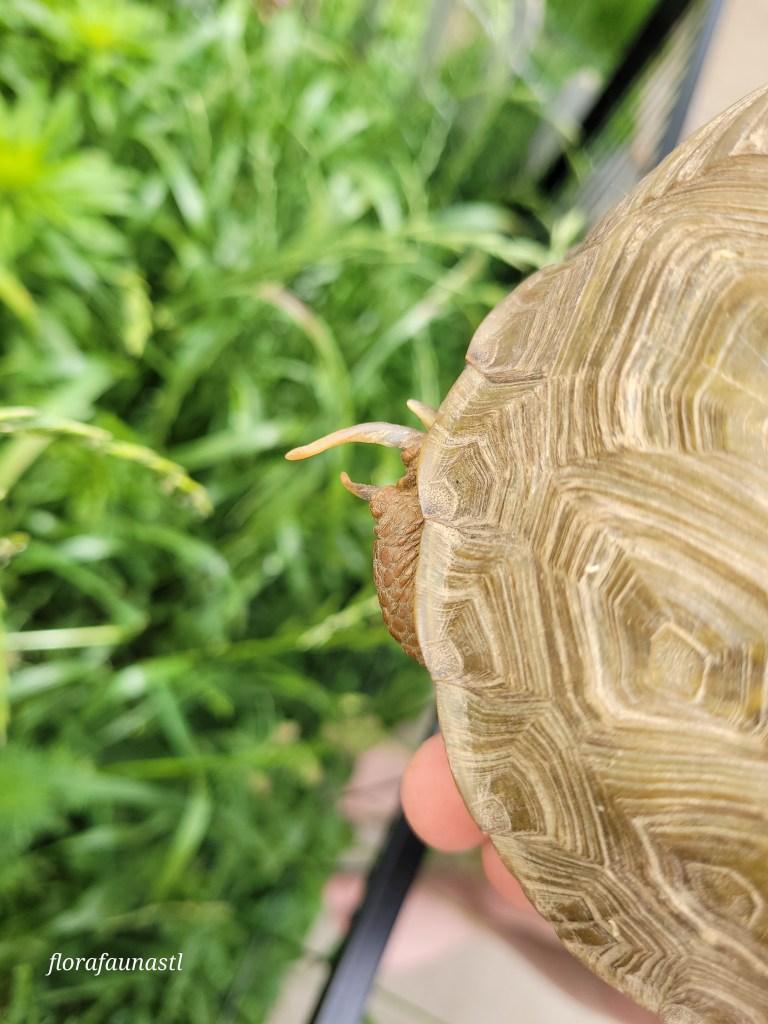
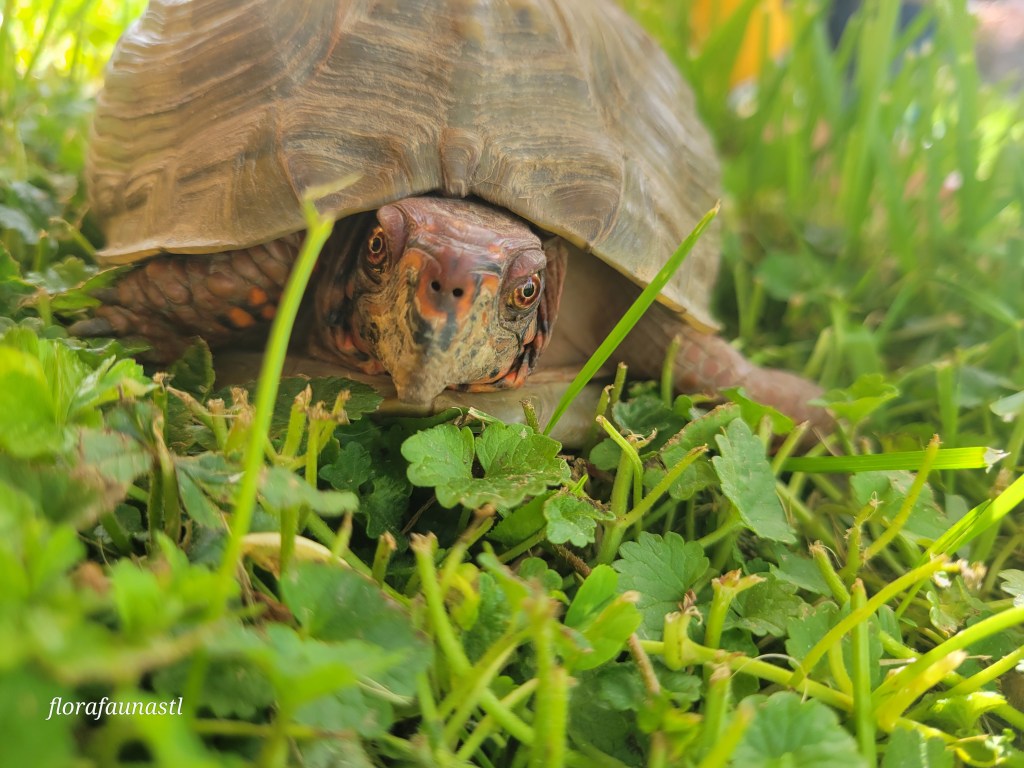
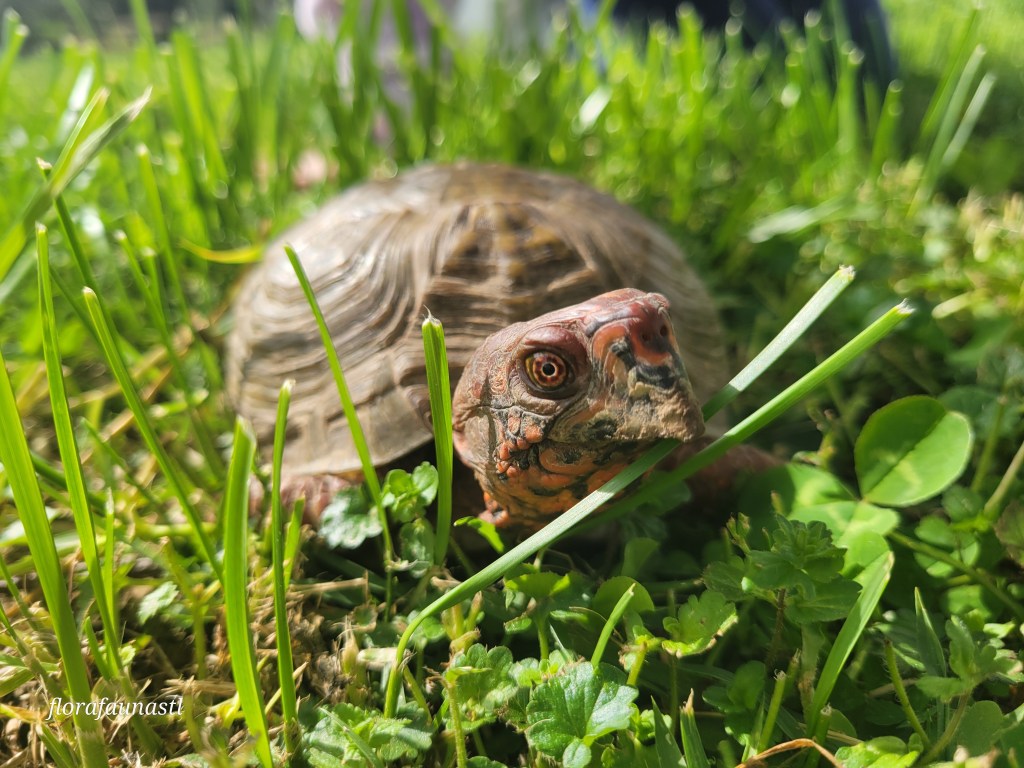
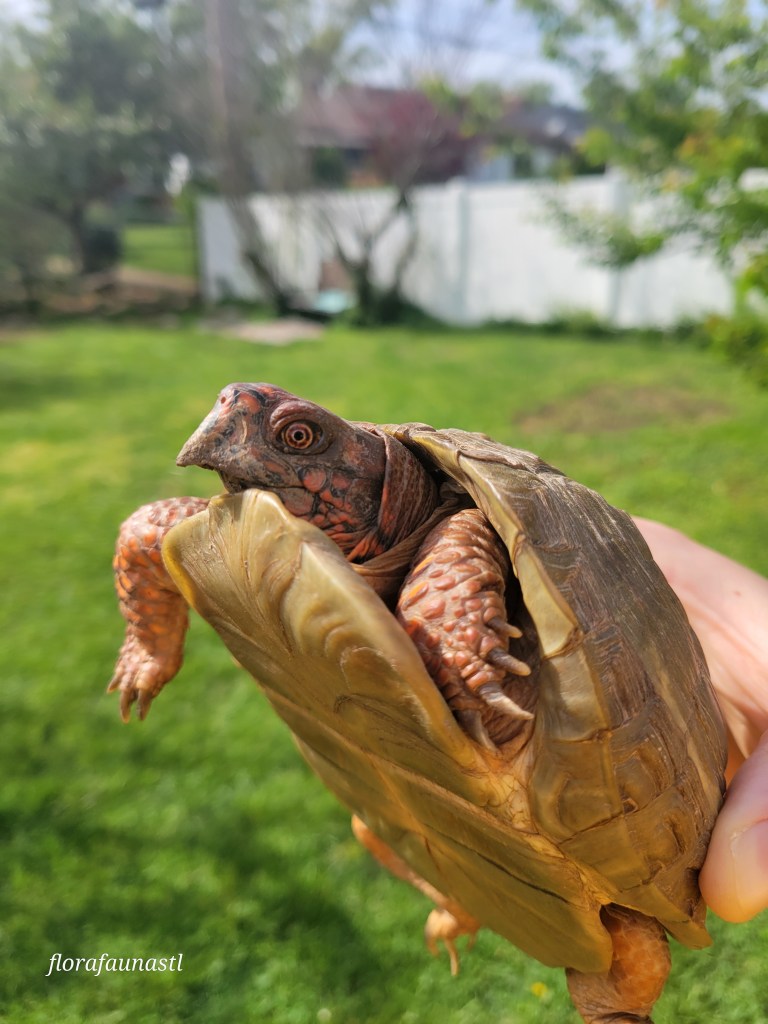
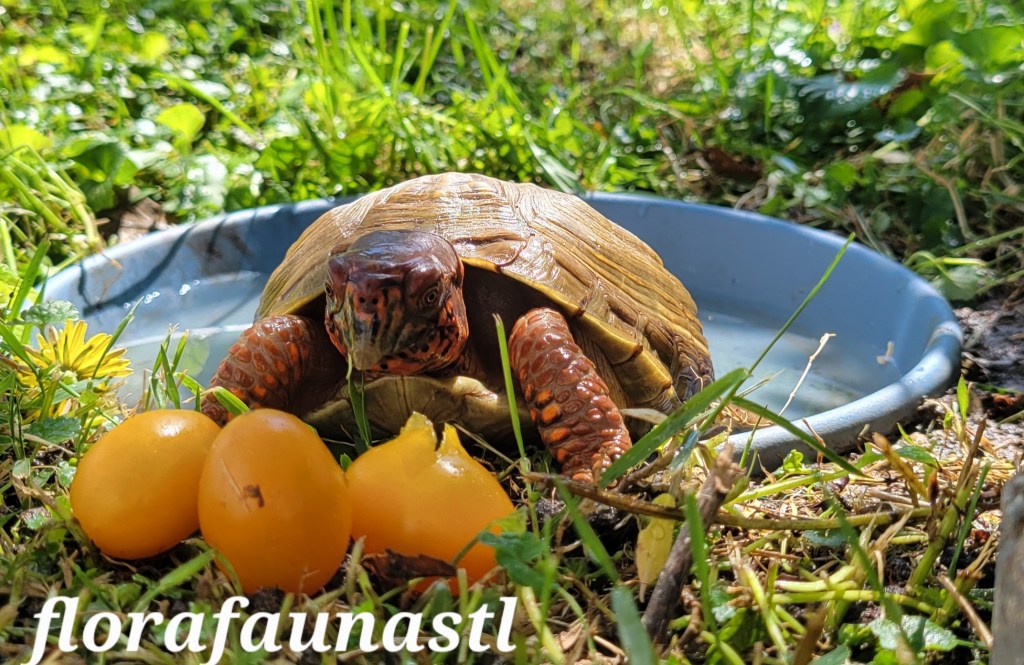
The skin of Three-Toed Box Turtles is dark with yellow and orange scales; males usually present bright orangish-red scales on their heads and neck, whereas females will have more dull and less colorful scales. As well, females tend to have yellow or brown eyes, while males have reddish-orange eyes. We observed the turtle in our yard for a while and made some quick observations through referencing our nature books. Shellington has bright red eyes and reddish-orange scales, and a thick tail, which points to this turtle being a male. Another observation was that he had really long nails; the hind limb nails in particular are so long they stick out of the shell. Strange for a wild turtle. As well, his top beak is very long; it hangs way over the bottom beak. Also strange for a wild turtle. Shellington also was very open to the kids petting the top of his head with their fingers and even sticks his head out further for them to pet him….and that’s when it hit me: this could very likely be a turtle that someone let go. Most wild turtles are not as open to being handled, let alone pet (I was bitten by a wild box turtle as a kid once for getting too close to its head), and the physical features of Shellington pointed to basement life or a farily bad diet if he is wild.
Wild Three-Toed Box Turtles have a territorial range of about 5 acres or so, and if you ever find a turtle, it is not good to move or relocate them far from where you find them, as they will spend their time trying to get back to their territory. Being conscious of all of this, we have left the turtle in the backyard in an area our dog can’t get to that is close to where we found him. I built him a little wood shelter with a small dugout area in the ground, and he has a watering dish big enough to cool off in. He has been observed on several occasions blowing bubbles from his nostrils with his head submerged in the water, which is admittedly adorable.

With where he is in our yard, he can leave if he wants to, but has yet to go, and the family is happy to have him in our garden. The kids bring him tomatoes, berries, and even dig up and find earthworms for him that they leave in his area. In the wild, their diet consists of insects, worms, berries, roots, mushrooms, and other vegetation, and Shellington is being fed what he would naturally eat, despite his pleading for Imo’s. They are also very fond of eating the periodical cicadas we get in the region every 13 years.
I will be monitoring the situation and see what he does if he is still in my garden when winter approaches. The two turtles my father let go in the summer that we had for years and years were found dead when winter came around, as they didn’t remember how to overwinter. Had my father told me he was letting them go, I would have stopped him. If Shellington is not preparing himself for winter, I may have to bury him to help him or move him into the garage, where it is warm enough for him to survive before letting him back out in spring. But I am really hoping he overwinters on his own, and is simply a wild turtle that has lived in secret from me and the neighbors for over a decade. Wild Three-Toed Box Turtles do not hibernate like mammals but instead perform what is called brumation, which involves them digging a shallow hole of only a few inches, ideally under leaf litter and foliage, before going dormant through winter by lowering their metabolic rate and eating significantly less. There are some studies that show they produce a type of antifreeze within their system that allows the heart to continue pumping despite the freezing temperature.
Because of their inability to dig deep enough, Jack Frost claims large amounts of the population yearly. One thing I found particularly interesting is that if there is snowfall, it’s actually better for the turtles because it helps to insulate them from the cold winter temperatures. Once the warm rains come in spring, these turtles will come out of brumation and look for food and mates. Mating occurs from April to July, and eggs are laid a month or so after mating. Females lay about 5 eggs on average in shallow holes about 3.5 inches deep. The eggs hatch in about three months unless they were laid later in the season, in which case they overwinter and hatch when the warm spring weather returns. The turtles are fairly defenseless when born, only measuring up to a little over an inch when born, and are easy pickings for predators. Once they reach maturity, their primary causes of death are disease and, as we just covered, winter.
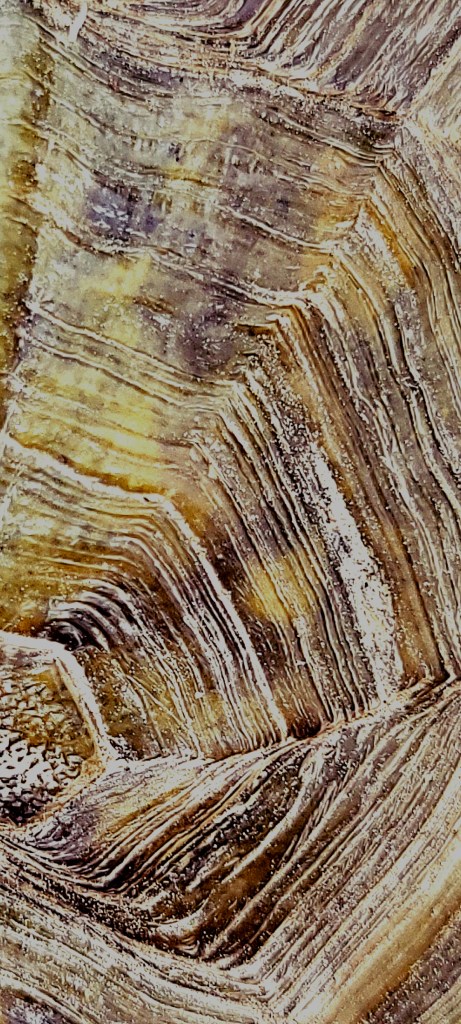
Despite these obstacles, though, box turtles can live between 50 and 80 years in the wild. There are some reports of box turtles living to be 100+ years, but that is rare. You can get a rough estimate of how old a turtle is by counting the scute growth rings (annuli) and dividing by 2. BUT this will only be a rough estimate, as ring formation can be affected by environmental conditions and diet. In addition, once turtles reach adulthood, counting the rings will become exceedingly difficult and less accurate. Shellington is at least in his mid 30s if utilizing the ring counting method…which is really not accurate at all. That said I have no real idea of how old he is but I do hope he has had a good life thus far.
With the popularity of the Teenage Mutant Ninja Turtles having peaked in the ’90s, the prevalence of more and more finished basements, and the growth of environmental and wildlife awareness, I think we will continue to see the presence of turtles in basements fizzle out with time. The practice, though fascinating and strange, is archaic and inhumane. If you happen to find a turtle outside hiking, leave it there and take a picture instead. If you see a turtle crossing the road, put it on the side of the road that has more grass and woodlands. If you see a turtle heading for a storm drain, put it in a safe area away from the storm drain… but NOT in your basement! But if you see Turtles, the delicious chocolate and caramel covered pecan treat in your fridge, that you know your spouse or family member brought home… eat it and plead the 5th.
References:

Johnson, R., Tom,(2000), The Amphibians and Reptiles of Missouri (2nd edition), Missouri Department of Conservation, Jefferson City, Missouri
Behler, J. L. and King, F. W., (1979), The Audubon Society Field Guide to North American Reptiles and Amphibians, Alfred A. Knopf Inc., New York.
https://mdc.mo.gov/discover-nature/field-guide/three-toed-box-turtle


 Flora Fauna STL
Leave a comment