What critter has a bright blue tail that detaches?
What kind of mother broods their eggs until the last one hatches?
Who dines on spiders, crickets and other invertebrates?
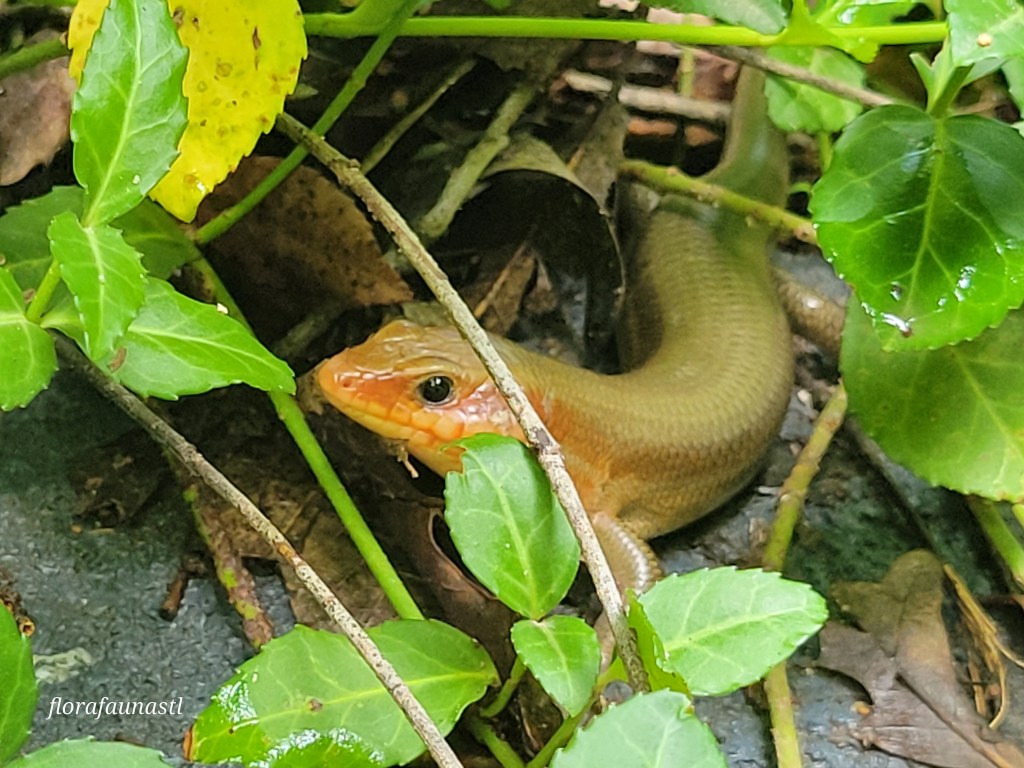
What male’s head turns orangish-red when he’s looking for mates?
Read on and I’ll tell you there’s no need to wait!!!
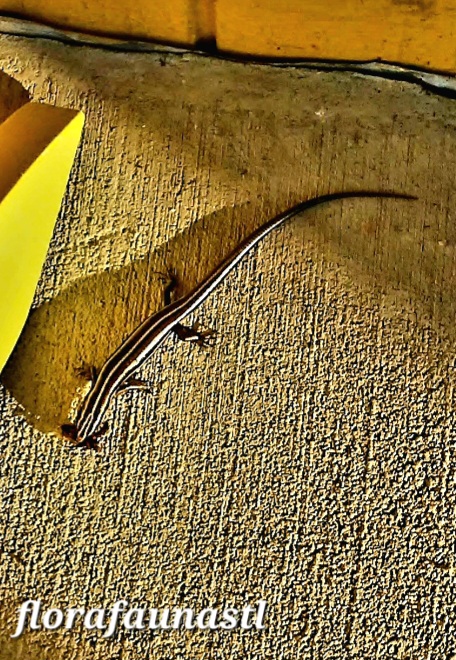
What does this ludicrously corny quintet and today’s animal have in common? They both have five lines! With this being the site’s first reptile, I was really trying to upscale the article for this one. Alright, I think the dad jokes and puns are out of my system so let’s learn about a lizard that you may see while walking along trails throughout wooded areas in the greater St. Louis region. During spring and summer, I have seen them racing off to safety while hiking along trails at Powder Valley and Forest Park. They are the most common lizard in North America, ranging laterally from the Gulf of Mexico into Canada and longitudinally from the wheat belt to the Atlantic. We are talking about Plestiodon fasciatus, more commonly called the five-lined skink. This name is derived from the presence of five yellow or white dorsal lines that the juveniles sport, along with a long bright blue tail. I always thought the bright color of the tail was to attract the attention of predators away from the non-replaceable body so they could escape if attacked. This is partly true, as they will wiggle their tail in hopes a predator goes for that instead of their head. However, the blue coloration is believed to signify sexual immaturity to older males, who lose the blue tail and white stripes with age, becoming a uniform olive-brown color. The adult males are very territorial and aggressive with one another and will only tolerate immature males and females being on their turf.

The five-lined skink has the ability to detach its tail, an evolutionary feat known as autotomy. They have evolved what is known as a fracture plane, think of a bony and musculature structure that works similarly to a pen and pen cap. They fit snug enough to hold the tail together unless there is an event with enough pressure, in which case the tail detaches and thrashes about to distract any would-be predators. The tail will eventually grow back, but the loss of the tail is taxing on the lizards. Their balance will be off, it has a negative impact on their mating, and the next time a predator comes along they won’t be as lucky if the new tail hasn’t grown out yet. On a side note, I can never talk or read about detachable tails without thinking about Toonces The Cat’s “World of Nature”. It was a very obscure 1990s SNL skit that my father had on laser disc, and I watched it often. Back on topic though, as stated earlier the coloration of these skinks changes color as they mature, the males become an olive-brown color and may lose their stripes completely, but they do have an orangish-red coloration around their head. The females will also change in color as they age but are more likely to retain the blue tail and their stripes.
There is another species that looks extremely similar to the five-lined skink, and that is Eumeces laticeps, commonly called the broad-headed skink. In fact, juveniles of both species have five stripes and blue tails. The only way to definitively tell them apart is by looking at their scales. The five-lined skink has seven labial scales (side of head), two postmental scales (under chin), and have parallel body scale rows. Five-lined skinks are also smaller, reaching max body lengths between 5 to 8 inches. Despite their small size, they are voracious eaters and feed on a wide variety of foods. Their diet consists mainly of invertebrates, but they will occasionally eat small (baby) mice and potentially other lizards. In addition to their carnivorous menu items, they well also gorge themselves on fruits. They can inhabit a wide array of habitats from backyards to fields, but they prefer to be in wooded areas with lots of downed trees, rocky bluffs, and plenty of places to shelter. Most of us will probably encounter them as we see their blue tails darting off into the woods or under a stump as we hike through the woods. They may seem to be overly skittish, but in their defense, they have a long line of predators hoping to make a quick meal of them. The usual predators are hawks, opossums, raccoons, snakes, lizards, and notoriously cats.

They leave their overwinter dugouts around April and start to become sexually active shortly thereafter. The males become hyper-aggressive towards one another and, perhaps for a good reason. There is no monogamy in the world of the five-lined skinks, and in fact, some clutches of eggs have been found to have several different fathers. During mating, the male will bite down on the female’s neck to hold her in place while inserting his hemipenis into her cloaca. Let’s define some terms here for educational purposes. A hemipenis is one of a pair of the male reproductive organs of squamates (the largest order of reptiles) which are hidden under the scales near the tail. They are often spiked or barbed to hold itself in place until mating is complete. A cloaca is a single opening at an animal’s rear that serves all of the expelling of waste needs (urine and feces) as well as reproductive functions. All reptiles, birds, and amphibians have cloaca and even some mammals. If you are learning about this for the first time…count your blessings and be happy you are a placental mammal. With that fun reproductive educational piece out of the way, let’s get back to the lifecycle of the five-lined skink. About a month after mating occurs the female will lay between 7 to 14 eggs. She will look for a moist and covered area that will help to keep the eggs from drying out as well as offering protection from predation. Females will stay with the eggs to defend them and will attempt to keep moisture levels consistent by urinating on them or moving soil around. Sometimes females lay eggs communally and take turns going out for food while others guard the nest. The eggs are not hard-shelled and will grow in size over the next one to two months. Any eggs that start to go bad will be eaten by the brooding mothers, calories are calories…am I right? The hatchlings will emerge at roughly 2.5 inches in length and will be with their mother for a whopping day or two before they part ways.
Five-lined skinks are fascinating creatures and have captivated observers for generations. There is a misguided belief that these lizards are poisonous and are even referred to as “scorpions”. It is believed this name is derived from their waving of the tail as a defense mechanism when cornered. Let me assure you they are not poisonous and even if one were to bite you, they are unlikely to even break the skin. There are, however, real scorpions in St. Louis, and you can read about them here. Five-lined skinks are essential to the balance of our ecosystem and are such a fascinating creature to observe. Let me know where you have seen them, and until next time, go out and explore!
References:

Johnson, R., Tom,(2000), The Amphibians and Reptiles of Missouri (2nd edition), Missouri Department of Conservation, Jefferson City, Missouri
How lizards keep detachable tails from falling off
https://mdc.mo.gov/discover-nature/field-guide/common-five-lined-skink

 Flora Fauna STL
Leave a comment