A few weeks back, I was bored and passing time by flipping through posts on the Nextdoor app. It was there that this journey began. One neighbor posted a picture of a dead scorpion in her toilet. I was blown away, and like many other users, I thought maybe this came back with them as a stowaway from their travels. Scorpions in Saint Louis, that is not a thing… or is it? As more and more commented on this post, others were sharing their scorpion finds and infestations. A few of the commenters stated that they lived in houses that backed up to River Des Peres. This would be the first animal that I intentionally set out to capture and document. I had to see this with my own eyes in order to believe it. I looked up the species online and went through some of my books to narrow down what type of scorpion this could be. There is only one type of scorpion that can be found in Missouri, and that is the Striped Bark Scorpion (Centruroides vittatus). They are the most common type of scorpion in the United States, ranging east to west from mid-America down to northern Mexico. They break the mold that I once had of what a scorpion is and where they live.
To preface, I have never seen a scorpion in the wild and was under the impression that they inhabited deserts. In addition to this misconception, I also thought they were relatively large, tarantula-sized for the scale of my imagined scorpion. The Striped Bark Scorpion is a medium-sized scorpion, typically reaching no more than 2.5 inches in length. As for biomes, yes, some do live in the deserts. However, they have adapted to live in temperate grasslands and in coniferous and deciduous forests. They spend their days hiding under rocks, debris, and other shaded cool areas. Living a partly arboreal life, they have the unique ability to climb (most scorpions can’t) and will climb trees to hide under bark as well, hence their name. This ability to climb is why they will sometimes be found in people’s attics, truly frightening if unexpected. Although they can climb trees, they tend to live the majority of their life on the ground. Being nocturnal, they emerge when the sun goes down and hunt insects, spiders, and even other scorpions.
A fun fact: the larger a scorpion’s pincers are, the less toxic their venom tends to be. This is because it takes longer for the venom to incapacitate their prey, so they must hold them in place longer before they succumb to the venom. Striped bark scorpions have small pincers and are pretty venomous. Rarely are the stings fatal, but they apparently still hurt pretty bad and feel like a bee sting on steroids. The initial pain typically subsides within an hour; however, swelling is expected. Some people will experience blurred vision, seizures, difficulty breathing, chest tightness, nausea, vomiting, and in severe reactions, anaphylactic shock. Since I have never been stung by one, I decided to use extra caution during my hunt as I would rarher not find out if my body’s response was on the extreme end.
Armed with all of this knowledge, I mounted my noble aluminum steed (my bike) and headed out to River Des Peres. I assumed they would be hiding out under the rocks or fallen logs along the gravel trails next to Willmore Park. On my first day out there, I came across two disc golfers who inquired as to what I was looking for. When I told them about the scorpions, one of them pulled out his phone and showed me a picture of a scorpion. It was taken two years ago, and he spotted it during the daytime, lounging on the sidewalk. I now had another witness and verification that they had at least been seen in the area. Turning the rocks over, I found many insects and spiders, but no scorpions. Grasshoppers were plentiful, as were crickets and spiders. This let me know that there was plenty of food for the scorpions to eat if they were, in fact, here.
For two days, I searched the cracked rocky sides of River Des Peres, using sticks to turn over rocks, but no scorpions. After a few more days of this, a couple out for a walk along the gravel trail came across me flipping over rocks. They asked what I was doing, and after filling them in on my mission, they informed me that they, too, had scorpions in their basement and in their backyard. Again, their house backed up to River Des Peres, again I got more confirmation, and thus more confidence I was in the right place.

That night, I decided I would do a night hunt along River Des Peres and hopefully find them out hunting. Knowing that there are coyotes in Willmore Park, particularly along the river, is one thing, but the vagrants that use the trails was another. I had to be on my guard for many reasons on this night hunt. As I walked the trail with a flashlight, I could hear rocks and gravel moving off in the distance, but it was out of the light’s reach. I was not too thrilled about having to wait and see what or who may be further down the trail, so I kept my distance and looked carefully and quickly.
After about fifteen minutes of nothing on the trail or on the tops of the rocks lining the river’s edge, I turned to head back. And that is when my flashlight caught the tiny tanish-yellow and black-striped scorpion curled up and flattening itself on a rock. It took all I had not to yell out explicitly with excitement as I flung my backpack down and got out my Tupperware container. The scorpion put up little struggle and waltzed right into the container with its pincers raised. After capturing the scorpion, I saw a buddy of his with claws out and tail in striking position scurry by, and I figured I’d best count my blessings and depart unscathed.

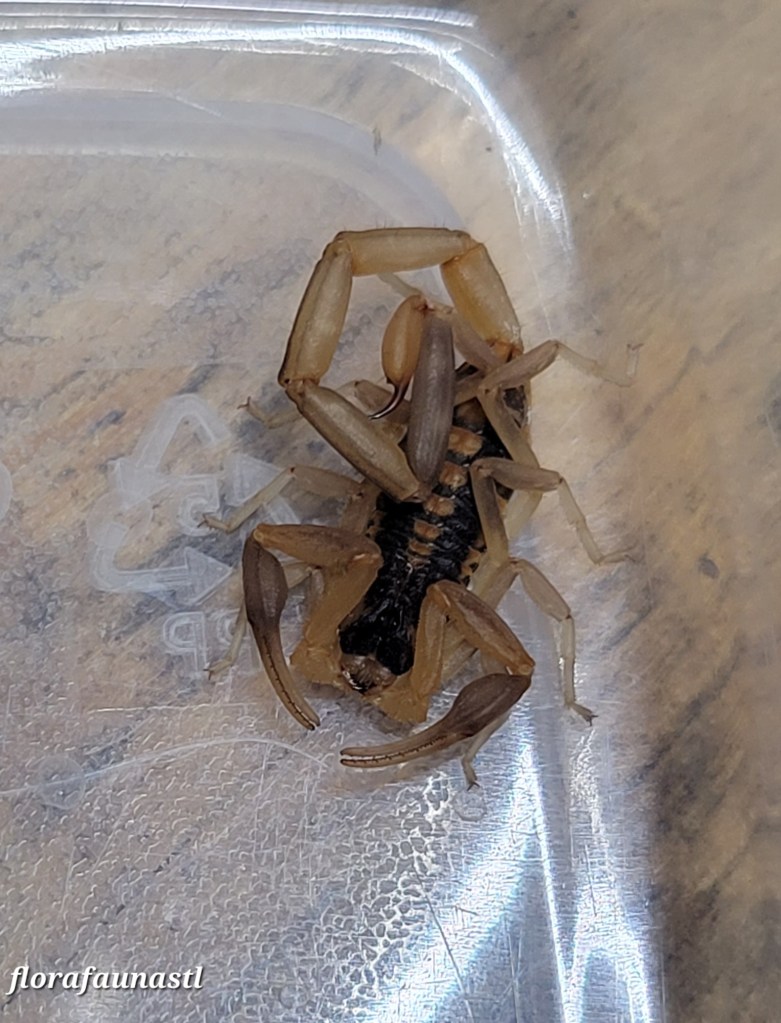
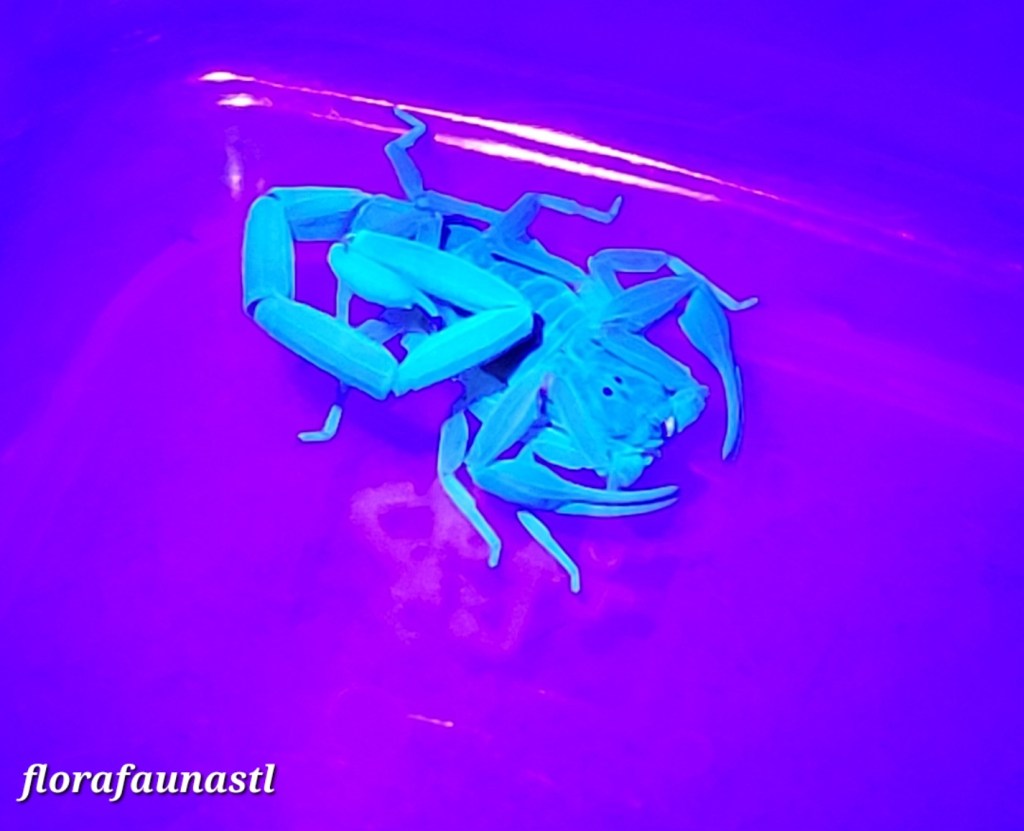
Once the lid was on, I took him home. As we pulled into the driveway, I noticed my neighbor Steve was working out in his garage. I brought my find over to show him, and he was just as surprised as I was, and we examined and photographed the scorpion. Striped bark scorpions are fluorescent, meaning they glow when exposed to ultraviolet lights such as blacklight. Steve went through a drawer and pulled out a blacklight flashlight, and our guest glowed a magnificent greenish-blue. It was absolutely magic!

The reason for this glowing evolution is still not completely understood by biologists, but we do know what causes it. Scorpions have exoskeletons, and in the cuticle of this exoskeleton is the “hyaline layer,” and this is what glows. The theories for its application are plentiful, ranging from luring in prey, alerting them they are exposed to UV (moonlight), or helping them realize they are not completely hidden during the day. Regardless of the reason for their glow, it is truly amazing to see first-hand. It also allowed me to easily see the eyes of the scorpion. They have two eyes on top of their carapace (head) and two to five eyes along the front of its body. Despite all the eyes, they have fairly poor vision and use hairs on their pedipalps (pincers) to help detect motion.
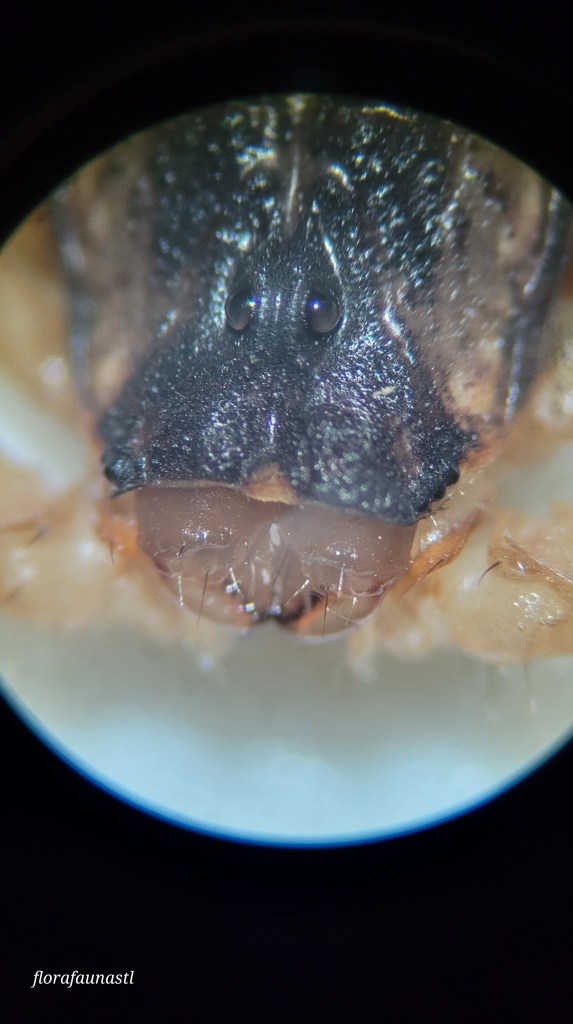
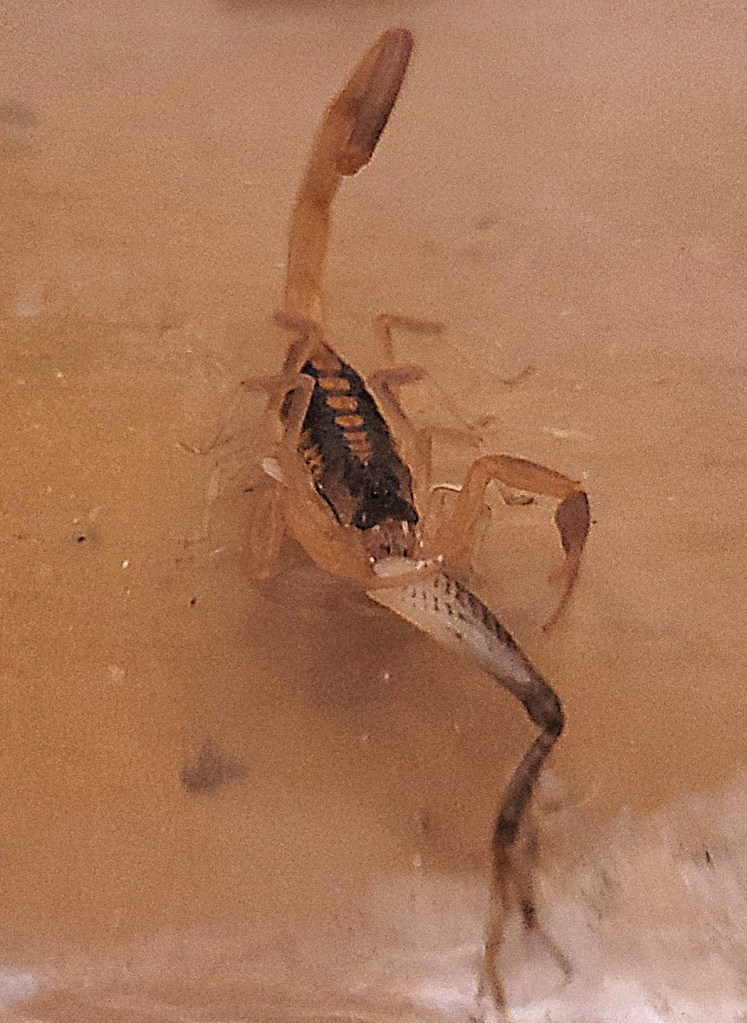
I am actually happy for their poor vision as the look on my wife’s face reflected an evolutionary disgust and fear of these arachnids that would have made him self-conscious had he been able to see her. Needless to say, my research had to be done in the garage. It was here, in a larger glass jar, that I got some great pics and realized the scorpion was searching for food. After running the perimeter of the jar once, it started eating the molt (old skin) of a spider that must have been in the jar at some point. Now, I have leopard geckos, and they eat crickets, so it felt natural to me to feed this hungry scorpion.
Normally, I would not interfere with the life and death balance of nature, but I also felt bad taking this scorpion out of his nightly hunt. What ensued with my dinner guest was nothing less than fascinating. After discovering the cricket, the scorpion displayed its hunting prowess and skill: grabbing, flipping, jumping, and stinging faster than the eye can really keep up with. The first go-around, it came away with a leg from the cricket and refused to part with it. In fact, it continued to hunt down the cricket while holding its leg upright in its claw-like mouthparts called chelicerae. The second go-around with the cricket proved successful, and the scorpion began to feast. Using its pincers, it positioned the cricket so that it could get into the soft areas past the exoskeleton and started gnawing away at the meat. I let it feed while I continued taking pictures and videos, but we were nearing 10 o’clock, and I had to get him home and get myself to bed. Although I was way too excited from my first encounter to sleep and ended up researching scorpions until at least midnight.
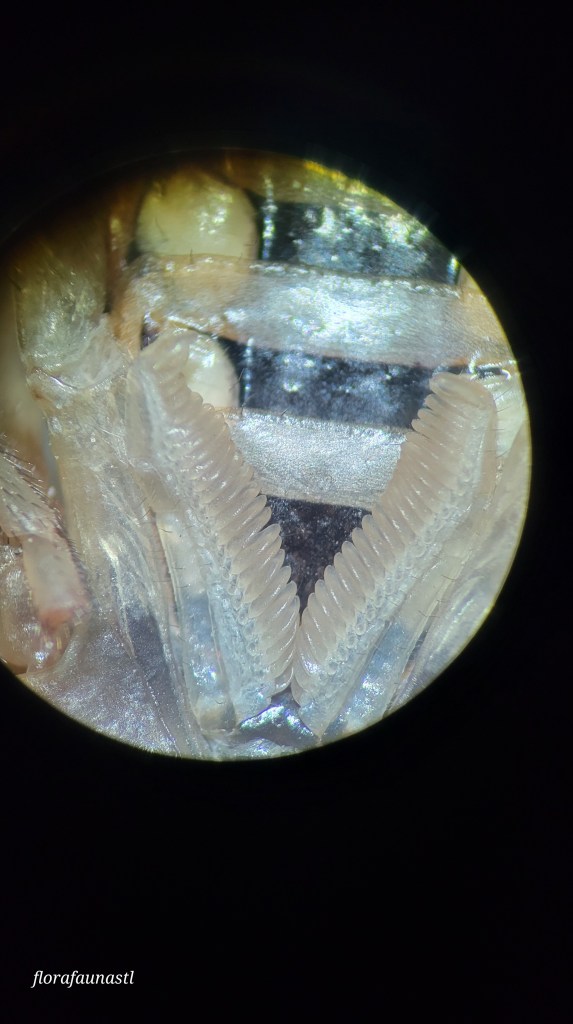
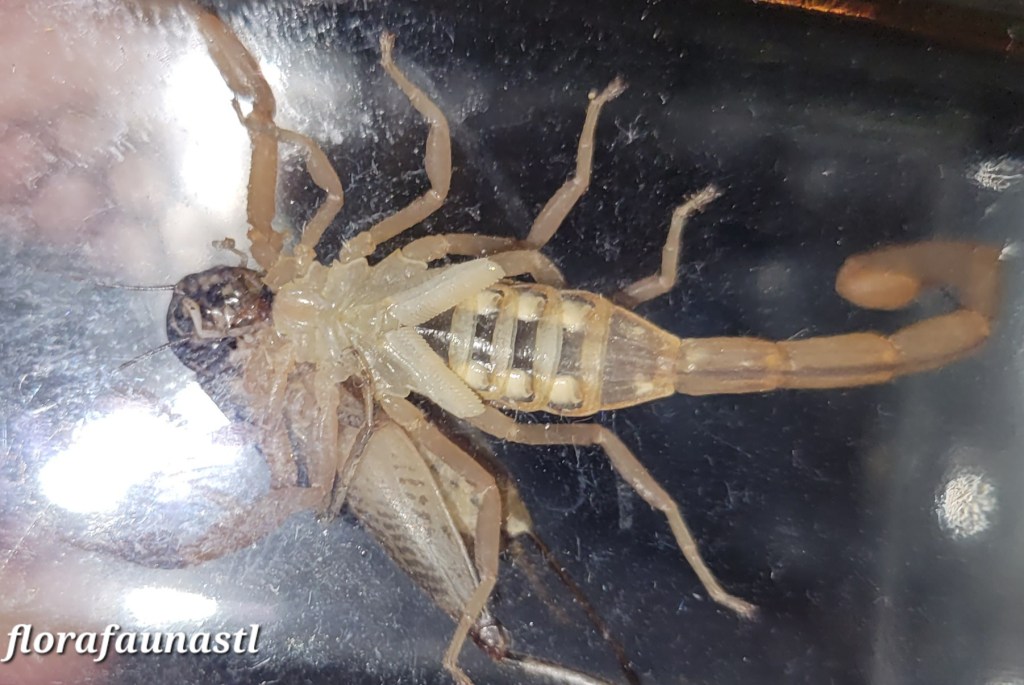
Once the scorpion was in the smaller jar, I noticed these strange comb-like structures protruding from its belly, and I had to figure out what these were. Turns out, these are “pectine teeth” and are sensory appendages used to find mates and hunt. Depending on the size, and ultimately more teeth on these comb-like structures, we can identify if a scorpion is male or female. Judging from how large this specimen’s pectine teeth are in relation to body size, compared to pictures I found online… I am fairly certain it is a male. Males also tend to be thinner, faster, and have longer metasomas (tails) than females.
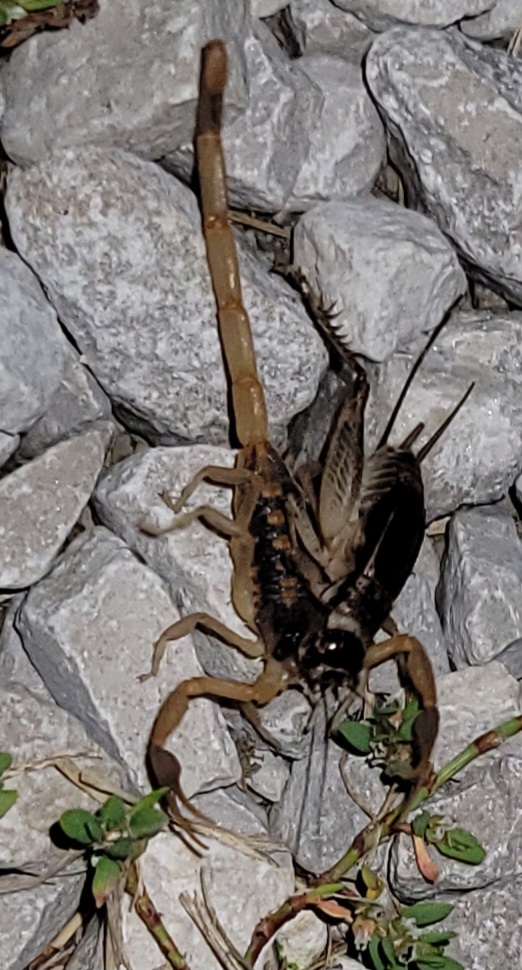
I eventually got him back into a smaller travel container, but he wouldn’t give up his well-earned catch. He flung the cricket leftovers over his back like a knapsack, and he was back in my car, on his way to tell his friends about the one rare human who was happy to see him. Again, it was now even darker and later than before, and I was out in a “no-man’s-land,” so to speak, so I wanted to move quickly. I released the scorpion and its catch close to where I found him, and he paraded around, showing off his catch, his stinger up and ready to strike. I must admit, for a creature that is a mere 2.5 inches, they are intimidating and do not seem to fear much. Although they do have a few predators that will eat them (birds, each other, some mammals, and lizards), they seem to be a formidable lunch.

Striped bark scorpions are also fairly social creatures (until they eat each other) and are, therefore, more often seen in groups and mate fairly often. Each year, there will be a few broods, with mating season lasting from spring to fall. The mating ritual can be found online for those who are truly interested, but I will give a very abridged version. The males will clash for dominance in mating circles; males will have to strong-arm the females and coerce them into accepting them as their mate. They then hold on to each other’s pincers in what is known as the “kissing pose.” The male will drop his sperm sack, then pull the female over it, and she will pick it up and put it where it needs to be. From that point forward, gestation is about eight months, and the mothers give live birth. This long gestation period is why females tend to be slower and larger than males. They are also cranky and more likely to sting than males, in all fairness though, being pregnant with an average of thirty baby scorpions does seem a tad stressful. Once the babies are born they will hang on to their mother’s back until they have their first molt at which time they will go off on their own. The younger scorpions will go through six molts until eventually reaching full adulthood. Older adults tend to lose their more defined stripes and become an overall brownish color with faint stripes. This species has the ability to live up to twenty-five years, although it is more likely they will live for about eight.
As I said goodbye to my friend, I had so many questions about this amazing creature quite literally being in my backyard. First, how long have they been here? Someone I spoke with who had them in his basement mentioned they first saw them in 2017. Second, how did they get here? With temperatures warming up and winters getting milder, there has been a fair amount of southern dwelling animals expanding their territoy to the north. These scorpions were traditionally found in the southern parts of Missouri and some Ozark regions. But now they are in St. Louis, maybe only isolated to the banks and yards and basements near River Des Peres, but who really knows. Are they just cruising on up, or were they accidentally brought here and established a population? The scorpion looked up at me, past its leftover cricket, and I felt he wanted to tell me the answers to all these questions, but I was afraid the truth may sting so I declined his offer to get closer. It seems for now the secret of the scorpion is safe with them, which is truly fine. I am just happy to have met one.
References:
https://en.m.wikipedia.org/wiki/Striped_bark_scorpion
https://mdc.mo.gov/discover-nature/field-guide/striped-bark-scorpion
https://academic.oup.com/icb/article/56/5/1022/2420629
https://www.terminix.com/blog/bug-facts/why-do-scorpions-glow-under-ultraviolet-light/
Beware the pregnant scorpion


 Flora Fauna STL
Leave a reply to Anonymous Cancel reply