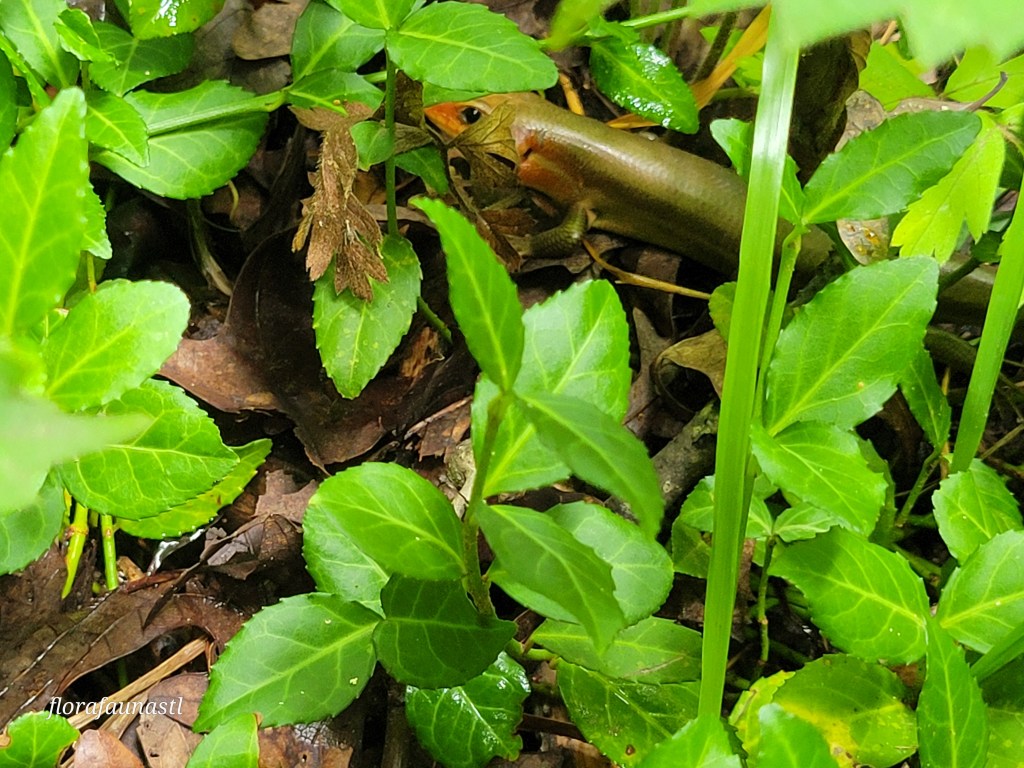
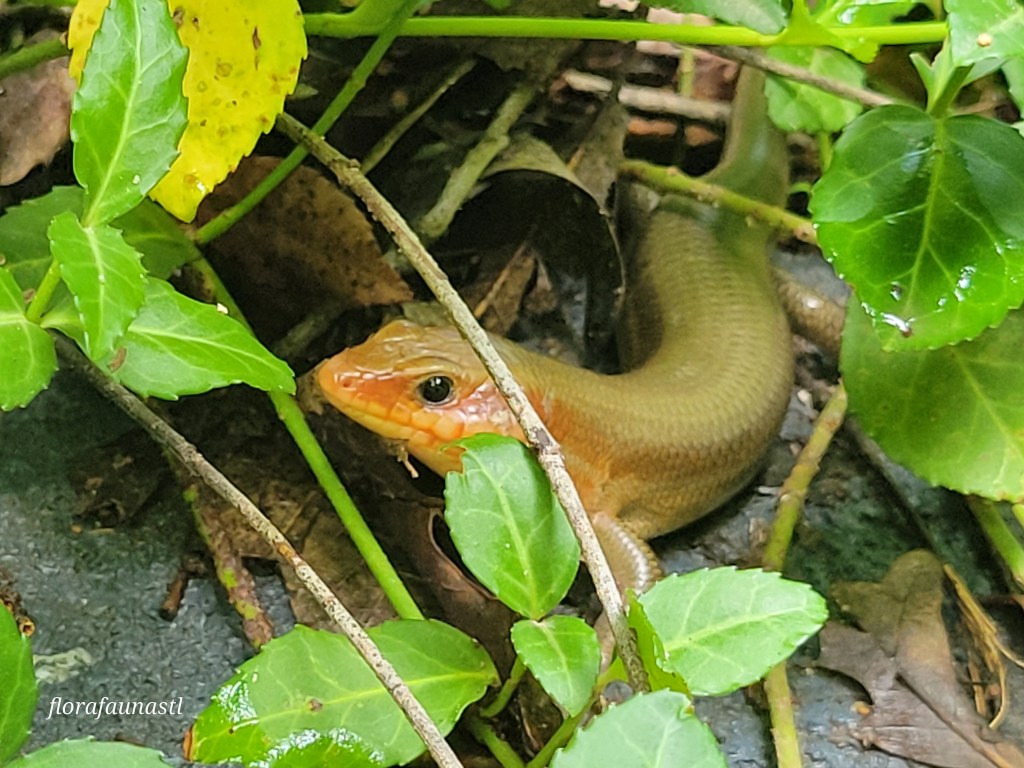
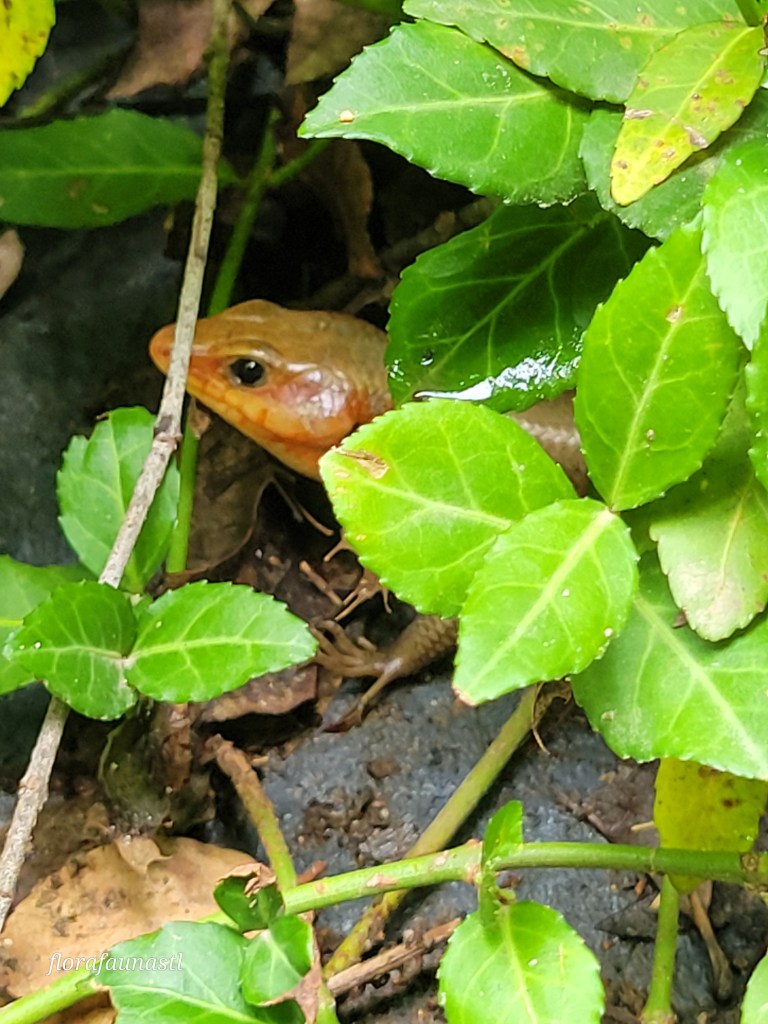
Father’s Day weekend of 2025 consisted of the perfect St. Louis weather for getting out and hiking, which is exactly what we did at Laumeier Sculpture Park. The kids love exploring the trails, finding artwork, and looking for animals and plants that stand out from the green sea of foliage around them. In the tree tops, they spotted Cardinals, Squirrels, and Blue Jays. On the ground, they spotted flowers, spiders, “giant ants,” and the coolest find of the day, which was this male Broadhead Skink (Plestiodon laticeps).

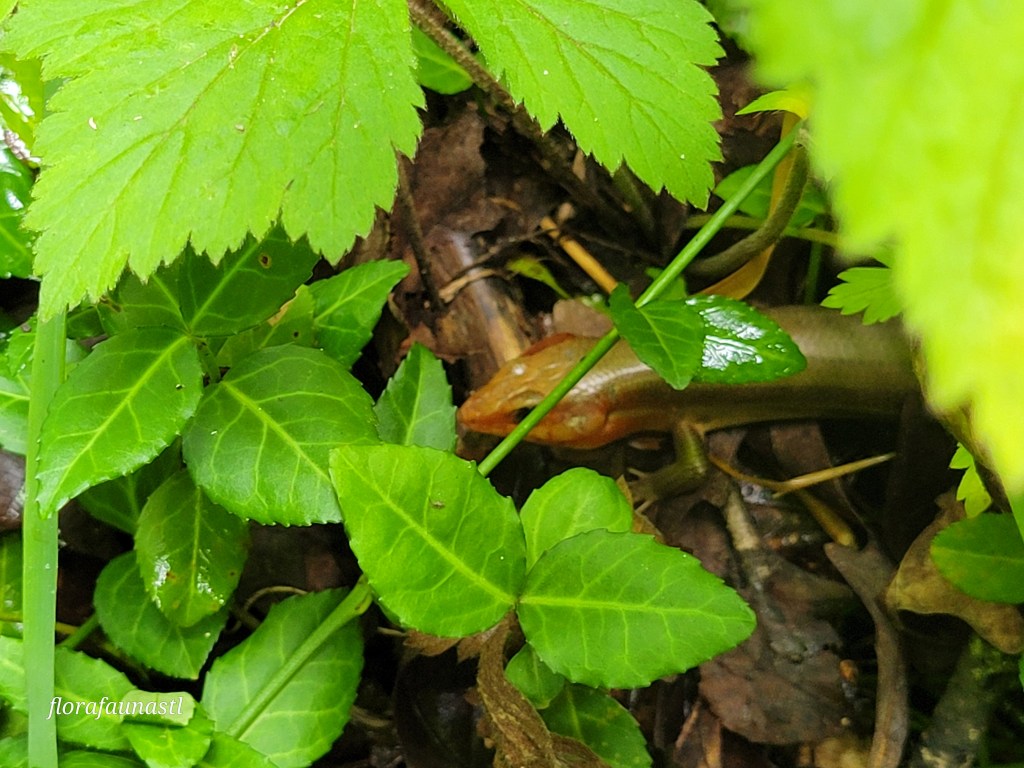
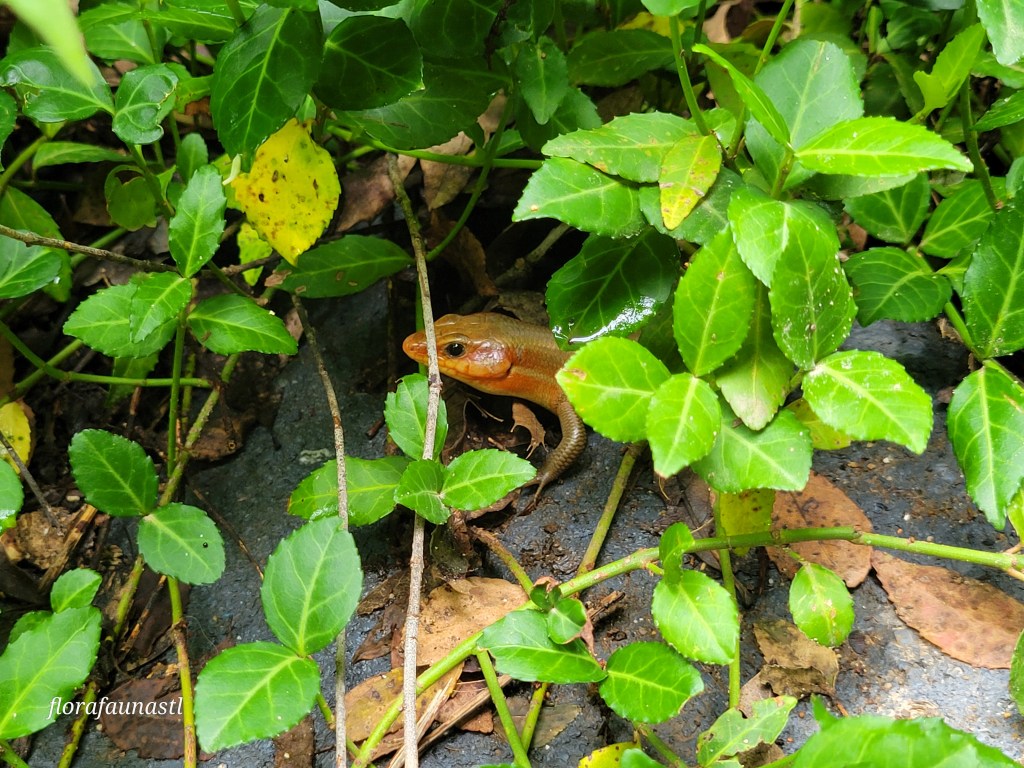
Broadhead Skinks are great examples of sexual dimorphism as adult males and females differ in both size and coloration. Males tend to be larger than females and have olive-brown skin with faint or no stripes running along their body. Males also possess large broad heads, which is the reason for this species’ common name: Broadhead Skink. Those large broad heads will swell in size and turn an orangish-red color during the mating season. The females, on the other hand, are tan to light brown in coloration and possess dark stripes that run along the sides of their bodies. Juvenile Broadhead Skinks are black with white or yellow stripes along their bodies and have bright blue tails, which is essentially identical to the coloration of the Five-lined Skink. The two species were actually considered to be one species, along with the Southeastern Five-lined Skink, until the early 1930s when Edward Taylor identified them as three separate species.
The species are able to be distinguished from one another by counting the number of labial scales (scales on the upper lip) as the Broadhead Skink will have 8-9 labial scales from the snout, with the 6th scale being the scale under the eye. While the Five-lined Skink will have 7 labial scales, with the 5th scale being the scale falling under the eye. In addition, the Broadhead Skinks are larger than Five-lined Skinks, with adults reaching between 6 to 13 inches in length. Keep in mind here that males of both species will have seasonal orangish-red heads, but the Broadhead Skinks will have broader heads and faint or no stripes, while the Five-lined Skink male will have a narrower head and visible stripes. With a few tricks on how to identify which species you are looking at out of the way, let’s talk about the life of the Broadhead Skink.
The Broadhead Skink can be found from the Gulf Coast up to the Midwest and spans from the East Coast to eastern Texas. They are active and voracious predators hunting down insects, spiders, smaller lizards, mice, and really anything else they can tackle and swallow. They are diurnal (active during the day) and live a semi-arboreal life, spending a lot of time in trees, favoring oak trees with abandoned woodpecker nests to hide in. When not scurrying around in trees, they can be found in areas with leaf litter and heavy foliage, which provide cover from would-be predators. Many animals will make a meal of these skinks, including birds, cats, canines, snakes, and even other skinks.
But as I learned at a very young age from watching the SNL skit “Toonces the Cat’s World of Nature” on laserdisc, many lizard species, including skinks, have evolved an interesting way to escape becoming a meal. The Broadhead Skink is able to perform what is called autotomy, which means they can self-amputate a body part due to specialized fracture planes; in this case, their tails will detach and flip around violently, distracting the predator while the skink scurries away and lives another day. Not only are they able to allow their tails to fall off, but they are also able to regrow their tail, although it will grow back more stubby and less pointy than their original tail.
I learned while researching this species that they are or were called “Scorpions” or “Scorpion Lizards” because people were under the impression these lizards were venomous and dangerous; this is absolutely FALSE! Although they can bite down fairly hard when being handled, which may not feel all that great, I can assure you that the pinch you received as a child for not listening in church hurts a lot worse.
Depending on temperatures, the Broadhead Skink is active from April through October, give or take, and its mating season ranges from April through June. During the mating season, males become more aggressive and defend their prime breeding territories, often around trees, from other males. They will engage in intense and violent fights, biting at one another and twisting and turning until one gives in and retreats in defeat. Males will seek out larger females, as they tend to lay more eggs per clutch than smaller females. Once a female and male have found their match, mating will occur, and the male will guard the female from other males for a few weeks, after which he is off to enjoy the rest of his summer. After about 30 days, the female will lay her eggs under fallen logs or debris, digging out a shallow nest for her clutch. Females will lay anywhere from 6 to 20 eggs, and some sources hint at communal nests, which are guarded by more than one female until the eggs hatch.
Once the young skinks have emerged from their eggs in July or August, they will begin actively hunting for prey to prepare themselves for winter, where they will brumate (go dormant under cover to wait out the cold). The Broadhead Skink will become sexually mature at around 2 years of age and can live for up to 8 years in the wild.
As a kid, reptiles were the cream of the crop for me to find, as they stand out among the other fauna we tend to see here in Missouri and in the world. Growing up in the shadows of Jurassic Park, anything close to a dinosaur got my little nature-loving gears revved up, and there is still something so cool about spotting a reptile in the wild. They always seem to be the cool cold-blooded masters of their environments, gazing through my soul. I imagine they’re questioning why the synapsids branched off from our common ancestors, the Amniotes, millions of years ago to become this semi-hairless ape that won’t leave them alone today. It is, however, completely possible I am projecting my own thoughts onto this lizard. After all, I really have no way of knowing what he is skinking about… I will see myself out. Until next time, go out and explore!!!
References:

Johnson, R., Tom,(2000), The Amphibians and Reptiles of Missouri (2nd edition), Missouri Department of Conservation, Jefferson City, Missouri
Behler, J. L. and King, F. W., (1979), The Audubon Society Field Guide to North American Reptiles and Amphibians, Alfred A. Knopf Inc., New York.
https://en.wikipedia.org/wiki/Plestiodon_laticeps
https://www.laumeiersculpturepark.org/
https://en.wikipedia.org/wiki/Amniote
https://mdc.mo.gov/discover-nature/field-guide/broad-headed-skink

 Flora Fauna STL
Leave a comment