Sometimes immitation will eventually lead to success, we have all heard the advice to “fake it until you make it” but some take that advice to the next level. No, I’m not talking about the guy at your office who is pretending to be Gordon Gekko or that one coworker whose laugh seems to awkwardly mimic whoever is around them. Those forms of mimicry are child’s play compared to the mimicry displayed by members of the family Syrphidae, more commonly called Hoverflies. This family of flies is unbelievably awesome for a few reasons. For starters, their coloration and body structure mimics many different species of Hymenoptera, the order that includes bees and wasps, so well that many people would swear on their life it was a wasp or bee thay flew by them. Some syrphidae even take it a step further by performing stinging motions when threatened to scare off threats, while others wave their front legs in front of them to mimic the antennae motions of wasps. Hoverflies are harmless though and lack the ability to sting or bite, and outside of their quick flying abilities, are defenseless against predators. They are great examples of Batesian mimicry, which is when a harmless species develops physical traits that mirror a species that is either dangerous or not very tasty to would-be predators. For other examples of mimicry see Ant Mimics: Euderces Pini & Castianeira Variata.
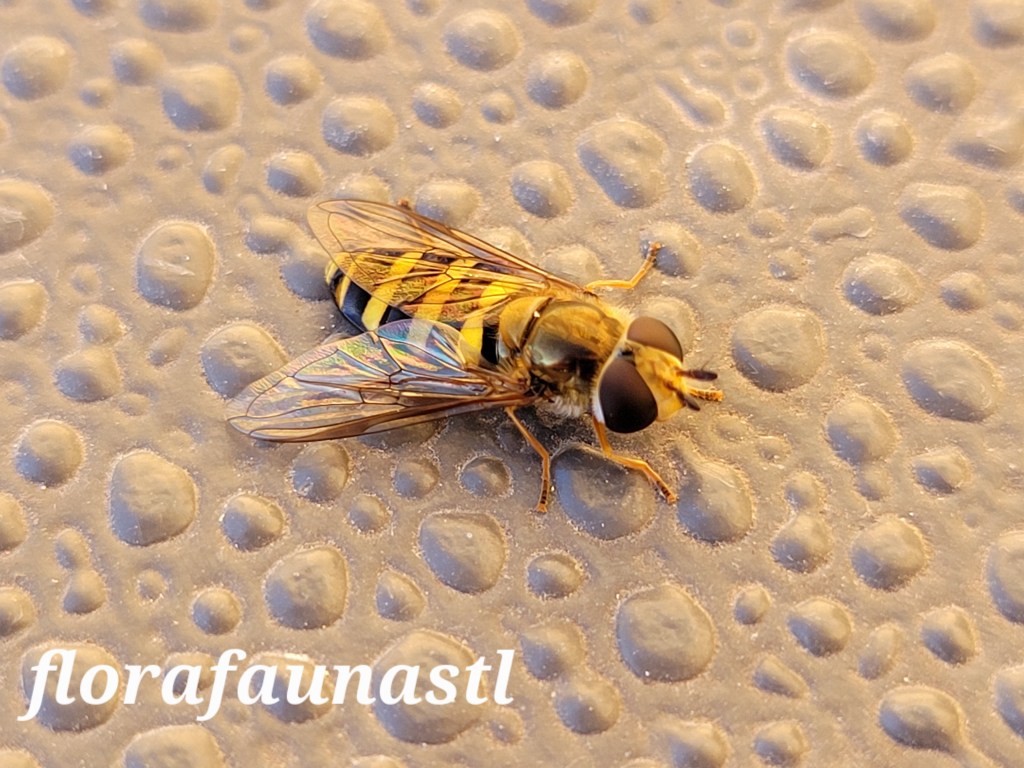
Although Hoverflies can’t sting like the bees and wasps they imitate, they do have one thing in common; and that’s playing a huge role in pollination. There has not been much research into Diptera (the insect order flies belong to) pollination until relatively recently, but that research suggests that flies rank second in pollination, only behind bees. And the Syrphids, or hoverflies, do the bulk of the pollinating for the Diptera order. Although some of the world’s 6,000 known hoverfly species visit only one or two plant species, the vast majority are not picky and will visit a wide range of flowers throughout their day. They have small mouthparts and therefore tend to seek out more open flowers to allow for easy access to nectar and pollen. Hoverflies do not carry as much pollen from one plant to another as bees do, but they make up for this by visiting many plants throughout the day; think of it as quantity over quality here. As the name implies, hoverflies are able to hover thanks to their ability to rapidly beat their wings, topping out at about 120 beats per second! In addition to this, all flies have uncanny agility for insects, and this is due to a pair of highly specialized organs called halteres.
Halteres evolved from the hindwings in the Diptera order around 250 million years ago, right around the start of the Triassic period. What were once wings are now small, club-shaped protrusions where the hindwings once were; they look similar to push pins in my opinion. These highly sensitive organs help flies to navigate in flight and aid in their balance and evasion of predators, or your fly swatter. One easy way to tell if the insect you are looking at is a bee, wasp, or hoverfly is by counting the wings; all flies will only have one pair of wings. The only other insects that have halteres and only one pair of wings belong to the order Strepsiptera, but their halteres developed where the forewing once was. The development in the separate orders of Diptera and Strepsiptera are great examples of convergent evolution, which is when two unrelated species evolve to have similar traits, like trading a pair of wings for a specialized sensory organ that aids in avoiding threats.
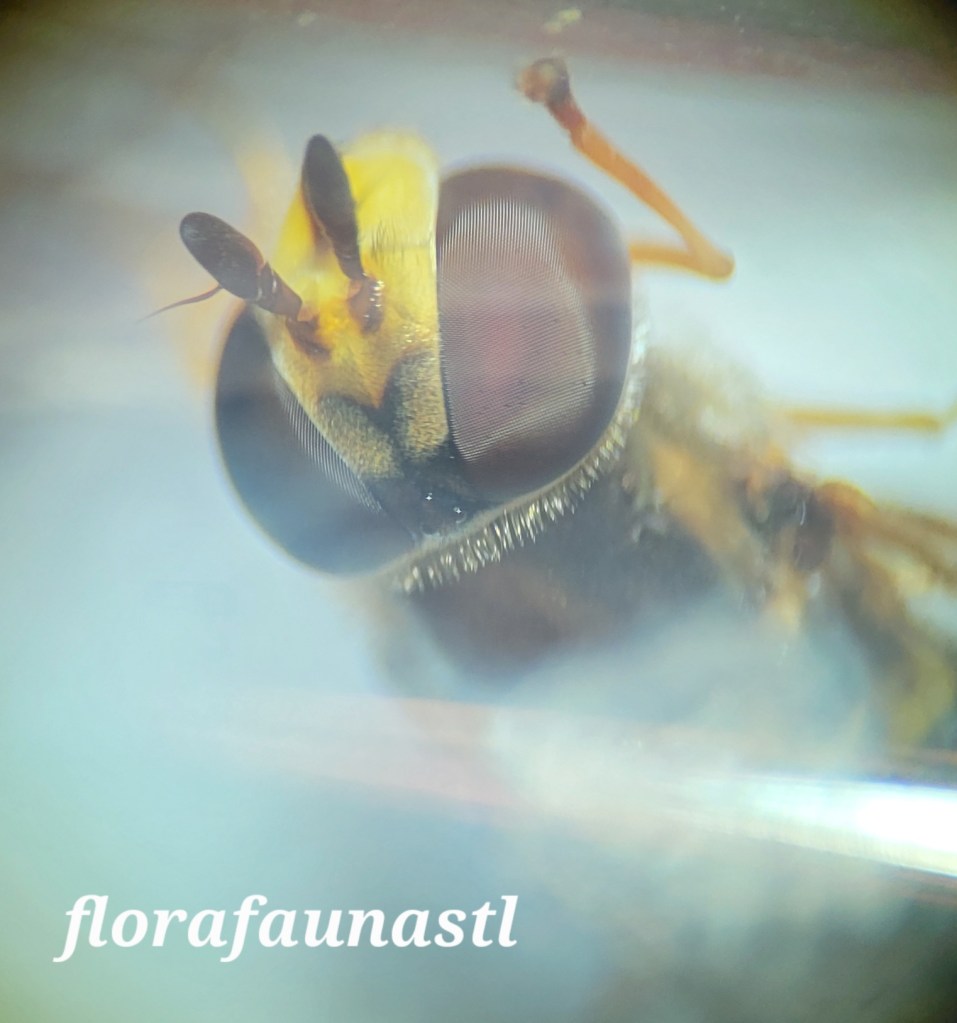
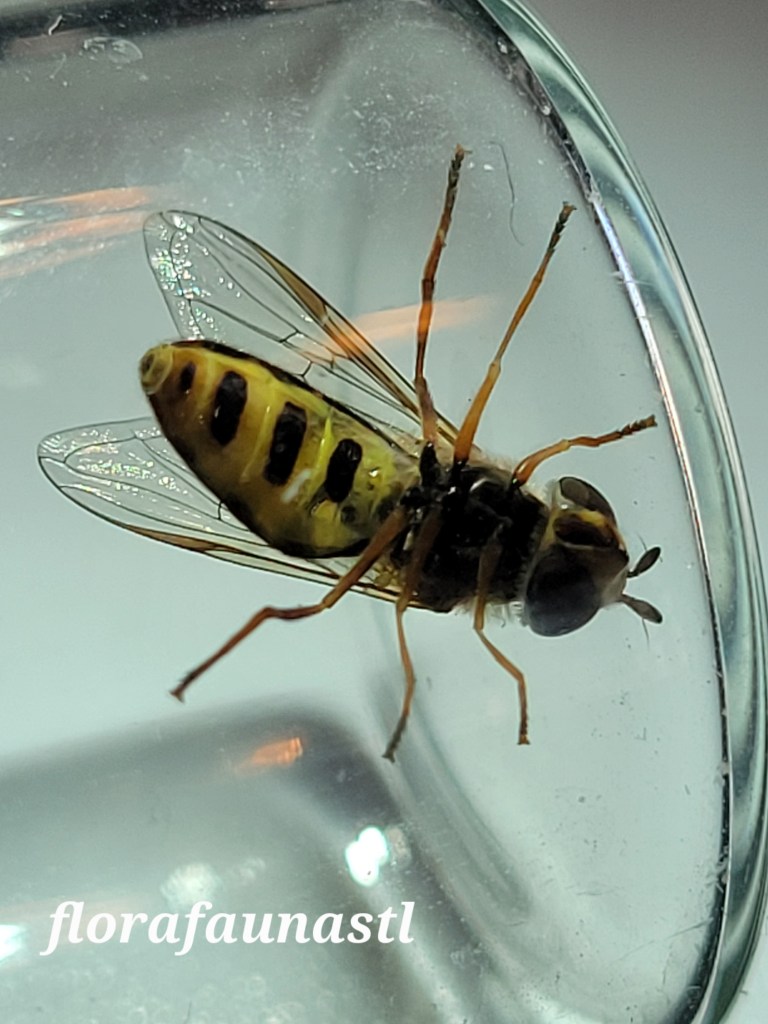
This particular species of hoverfly is either an American Hoverfly (Eupeodes americanus) or a Shot-tailed aphid eater (Eupeodes pomus). Both species inhabit much of the same geographical regions, which for the sake of this website is North America, more specifically St. Louis, Missouri. What I can be certain of is that this particular specimen is a speciwoman…that is to say, this is a female hoverfly. The sexes of these species can be identified by looking at the eyes; males’ eyes will connect or touch whereas the females’ eyes do not touch each other.
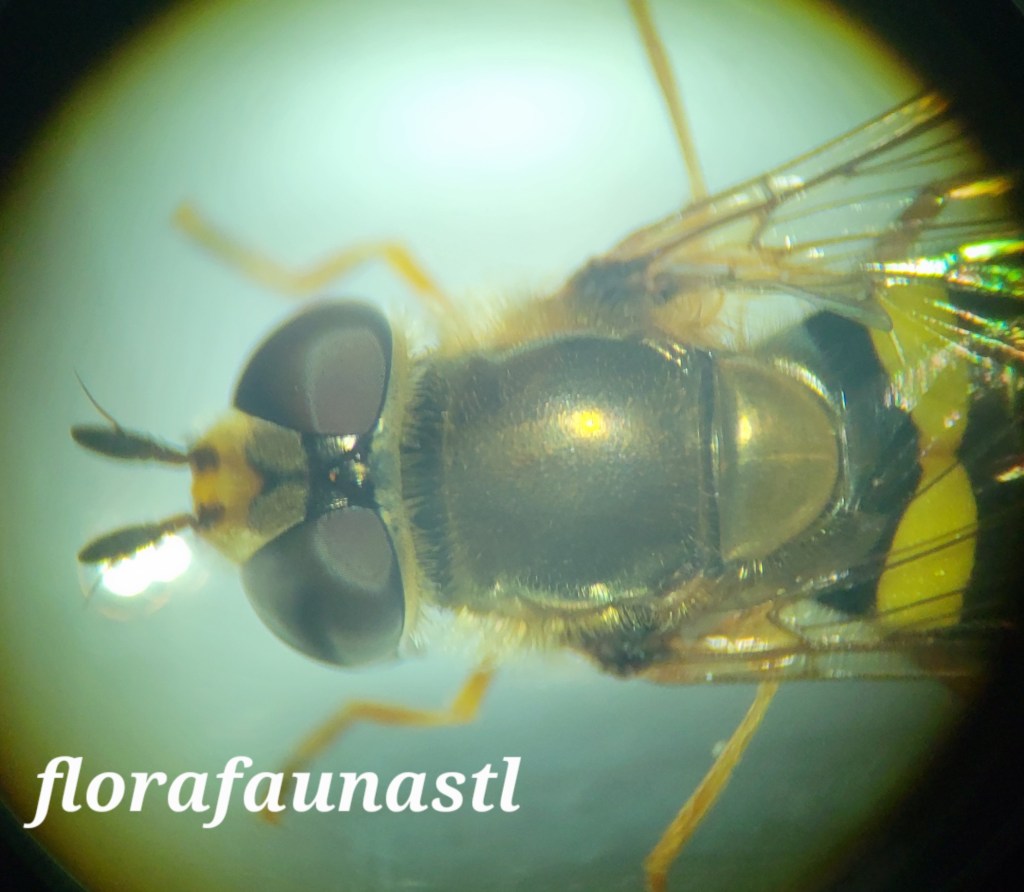
In addition to being fantastic for the pollination of crops and wildflowers, hoverflies are very helpful in other ways. As the name of the second contender for this species identification implies (short-tailed aphid eater), the larvae of hoverflies love to eat aphids, and they eat a lot of them. Some hoverfly larvae can eat up to 400 aphids during their development; obviously, this is hugely beneficial not only for the plant but for the farmers and gardeners as well. All flies go through metamorphosis, and hoverflies are no different. Once a mother hoverfly has found a plant with plenty of aphids, she will lay an egg on the stalk of the plant. The egg will hatch in about 3 days, and the aphid all-you-can-eat buffet kicks off. The larvae eat as many aphids as they can over the course of a few weeks and then they pupate for 2 weeks and then emerge as adults. Adult hoverflies live at most about a month, but they tend to kick the bucket at about 2 weeks. They use the phrase “Live fast and die young” as their motto, and you know what, I kind of admire them for that.
I have observed these Syrphids zooming around my yard (at roughly 8 mph) and I have seen plenty of them at the Missouri Botanical Gardens. They are out and about enjoying their short adult lives from April/May until October/November when the weather gets too cold and the eggs will overwinter. I know a lot of folks wouldn’t agree, but me personally, I find insect watching much more fascinating than birdwatching. There are 800+ known species of hoverflies in North America alone, and spotting and identifying them is a fun challenge for sure. And for the record, yes I do tend to look similar to the Bug Catchers who tried to battle you in Pokémon all those years ago. Keep the net and swap out the backpack full of Poké Balls for a backpack full of jars, and there you have me. I know some fly species can be annoying, but these ones don’t bug me in the slightest. Until next time, go out and explore!!!
References:
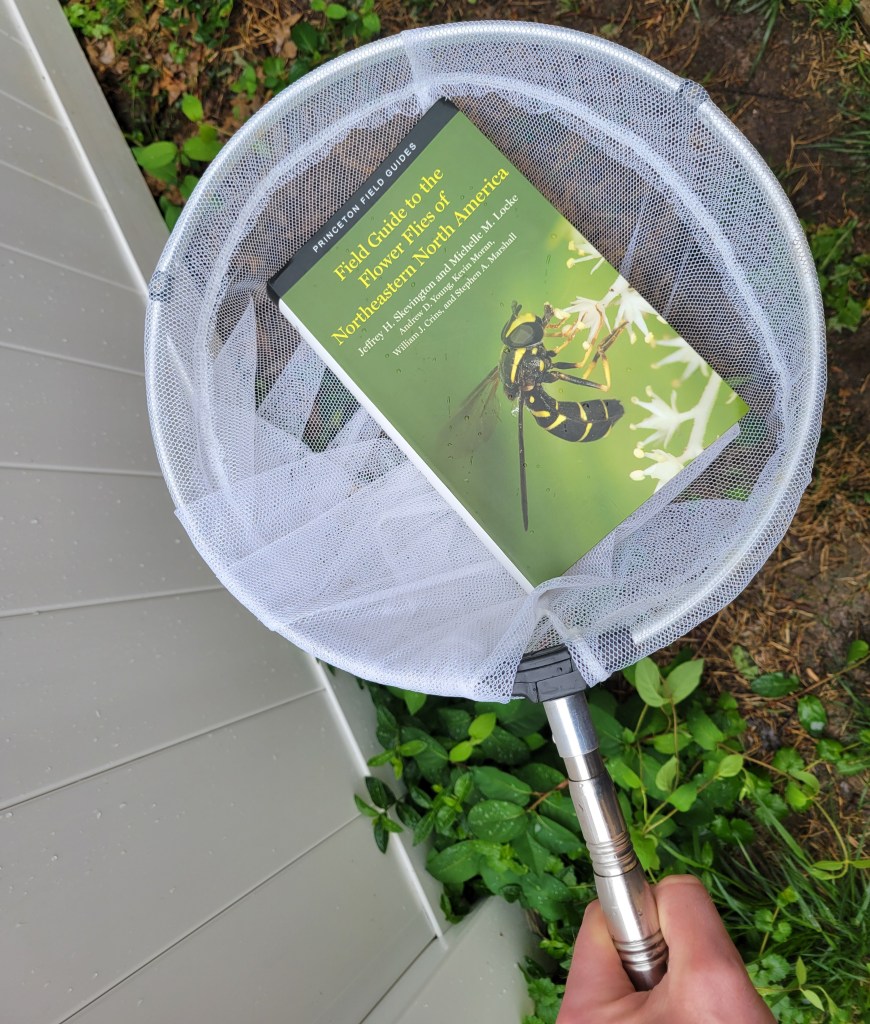
Skevington, Jeffrey H , Michelle M. Locke, Andrew D. Young, Kevin Moran, William J. Crins, & Stsphen A. Marshall. Field Guide to the Flower Flies of Northeastern North America. Princeton (NJ), Princeton, 2019
Milne, Lorus and Margery. (1980), The Audubon Society Field Guide to North American Insects and Spiders. Alfred A. Knopf, Inc., New York
https://mdc.mo.gov/discover-nature/field-guide/flower-flies-syrphids
https://en.wikipedia.org/wiki/Halteres
Hover, Flower or Syrphid Flies (Syrphidae)
https://www.annualreviews.org/content/journals/10.1146/annurev-ento-011019-025055
https://en.wikipedia.org/wiki/Eupeodes_americanus
https://en.wikipedia.org/wiki/List_of_flower_fly_species_of_North_America


 Flora Fauna STL
Leave a comment