
Our good friends the Webbs recently relocated to a cozy new home near Grant’s Farm. The subdivision is quiet, with low traffic and few street lights to break the darkness of night. There is an abundance of wooded areas surrounding the sprawling lush green yards, and many of the houses are equipped with swimming pools, including the Webbs’. The pool in their new home was out of service and in dire need of repair, as it hadn’t been used by the previous owner for several years. It had been collecting rainwater and debris that whole time and was not the ideal place to take a break from the summer heat for a human. The pool was also surrounded by a mini-forest full of trees brought in by squirrels and birds as the previous owner was not physically able to manage it.

Dave and Diane were both eager to get the area cleaned out and get the pool operating again, but for the time being, nature had staked its claim and its ambassadors were enjoying life. On one of our visits to the new home, the ladies were outside discussing the kids, life, the joys and stresses of parenting, and how they had the best husbands to have ever existed. At some point, one of the children discovered a frog under the table that quickly made an escape. I was inside watching a movie with Dave and talking house plans when one of the kids mentioned the frog. The hunt was on; I went outside and looked around for the animal that had evaded the kids, who by now had lost interest and moved on to other things. Knowing it couldn’t have gone far, I looked under the table and, sure enough, there was the frog, pressed into the corner of the table.

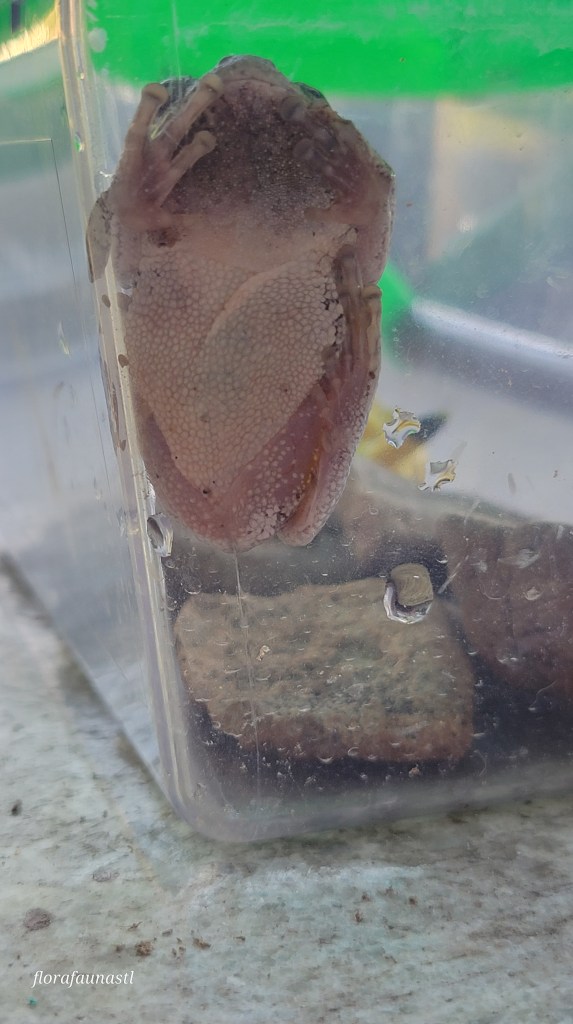


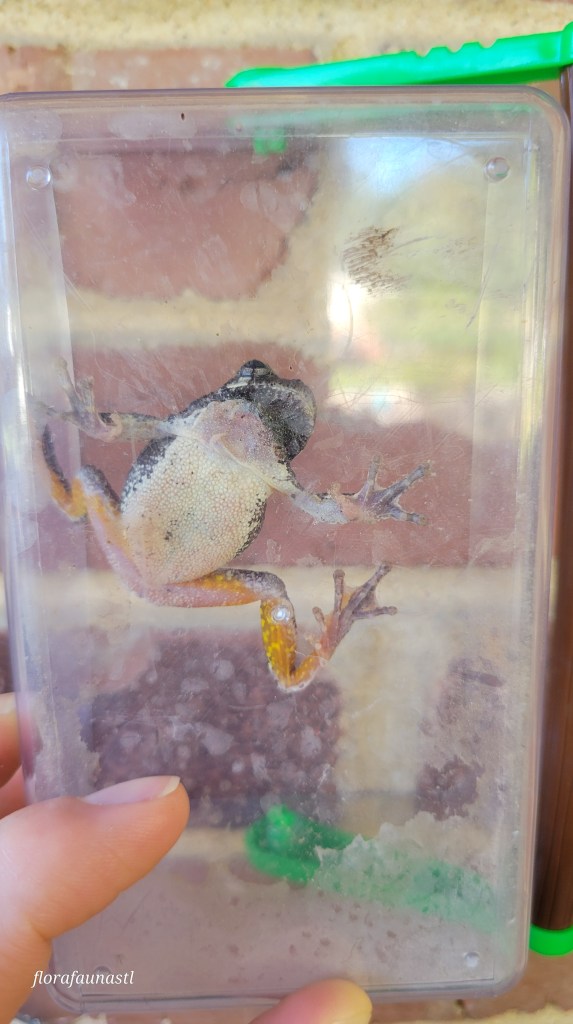
Dave got a container to put the frog in, and the kids gawked at him while asking questions about what he eats, what it is, is it poisonous, and of course “Can we keep him!?” It was one of those magic moments of summer where a stranger (for the kids at least) enters the area and the connection and curiosity with nature intensifies. I fielded a few of their questions and talked about the importance of respecting nature and letting animals live in their natural habitat. We talked about the differences between frogs and toads, and I informed them this was a Gray treefrog. Their curiosity waned after a while, and the allure of the electric-powered kid car and toy golf clubs were once again front and center.
The frog was no doubt in the area because this was the perfect habitat for a treefrog; a nice pool of water to lay eggs free of fish, conveniently placed below towering trees and overgrown brush. This was treefrog paradise, and judging from the chorus of frogs we could hear that night, our visitor was not alone in his choice of real estate. Now this specimen was a gray treefrog, that much I knew from my own curiosity being fed as a child, but what I didn’t know was what kind of gray treefrog, and to be honest, the two species are so similar that most books about them do not have separate entries for both species of gray treefrogs. And since I am not trained enough to distinguish exactly which one this was, I will follow suit.
This frog was either Hyla chrysoscelis (Cope’s gray treefrog) or Hyla versicolor (eastern gray treefrog); both species are simply called gray treefrog and their habits and habitats are nearly identical. They range from southeastern Canada to northern Florida and between the Midwest all the way to the east coast. They prefer to be near bodies of water (the Webbs’ pool) and live in a wide array of habitats, including but not limited to: woodlands, hardwood forests, small woodlots, swamps, and backyards. They are known to perch near porch lights and take advantage of the abundance of yummy insects the light attracts. Both species have warty or bumpy skin and possess the ability to climb vertically thanks to adhesive pads on their toes. They actually secrete a type of mucus through their toe pads that helps to create surface tension, which allows them to scale almost any surface with ease. This comes in handy as they spend the bulk of their summer living an arboreal lifestyle.
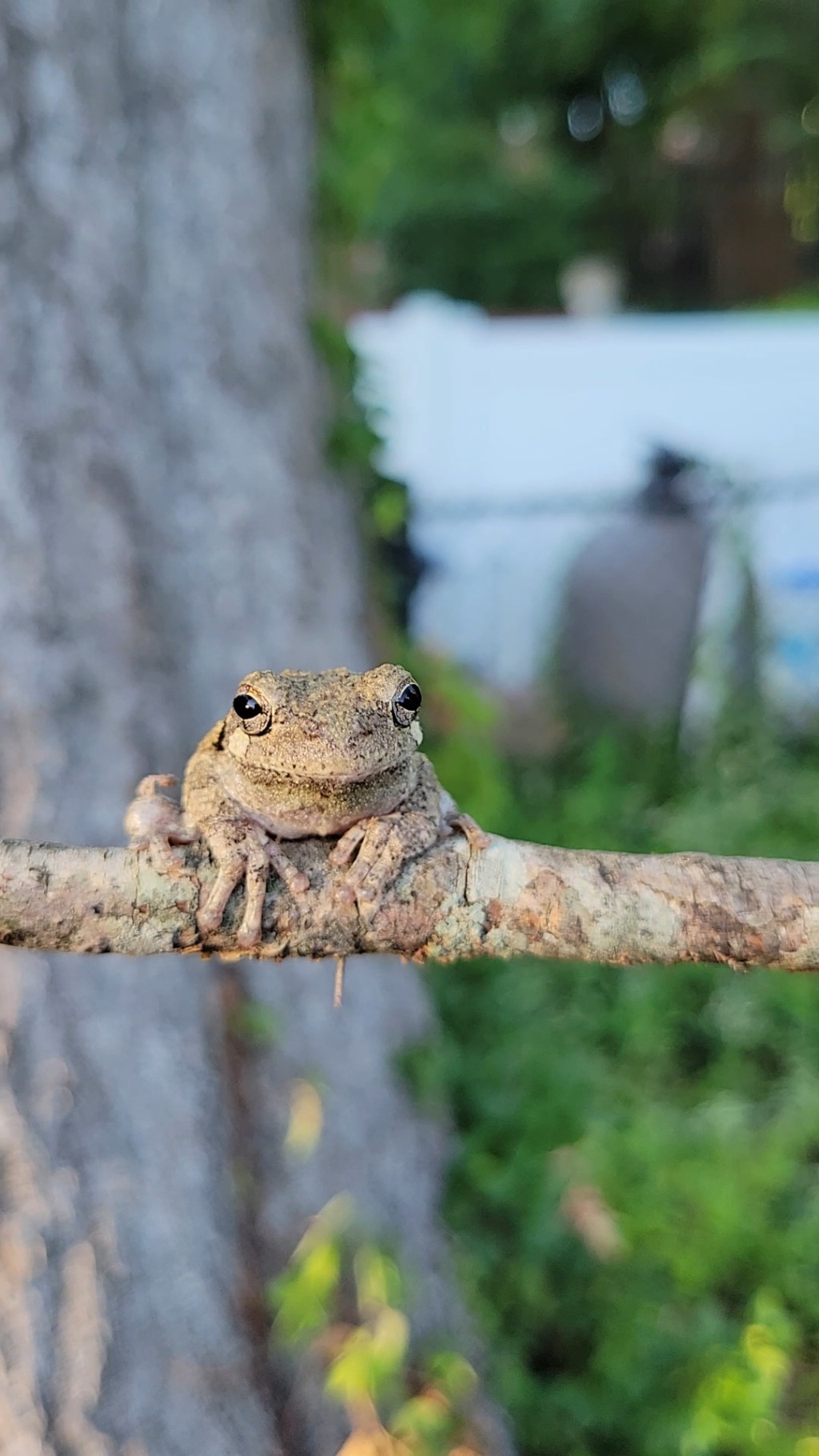
Despite the nomenclature of gray treefrog, their coloration varies (hence the versicolor) from various shades of green, gray, and brown with irregular patterns of black splotches as well. They are actually capable of changing their color quickly in order to camouflage themselves from predators. Their color also changes based on temperature and the time of day. For example, their coloration is typically darker during the night and brighter during the day. They all sport a large white spot below their eyes, and their bellies are white as well. Males do sport a darker-colored throat that is more visible during the mating season. They have bright yellowish-orange skin on the inside of their hind legs, which is believed to be a warning to predators of their toxic skin. Their skin secretes a toxin to deter predators and it can also irritate humans. The toxin can irritate the eyes, nose, mouth, and any open wounds one might have while handling the frogs. So long as you avoid touching your face and you are sure to wash your hands after handling these guys, you should be fine.
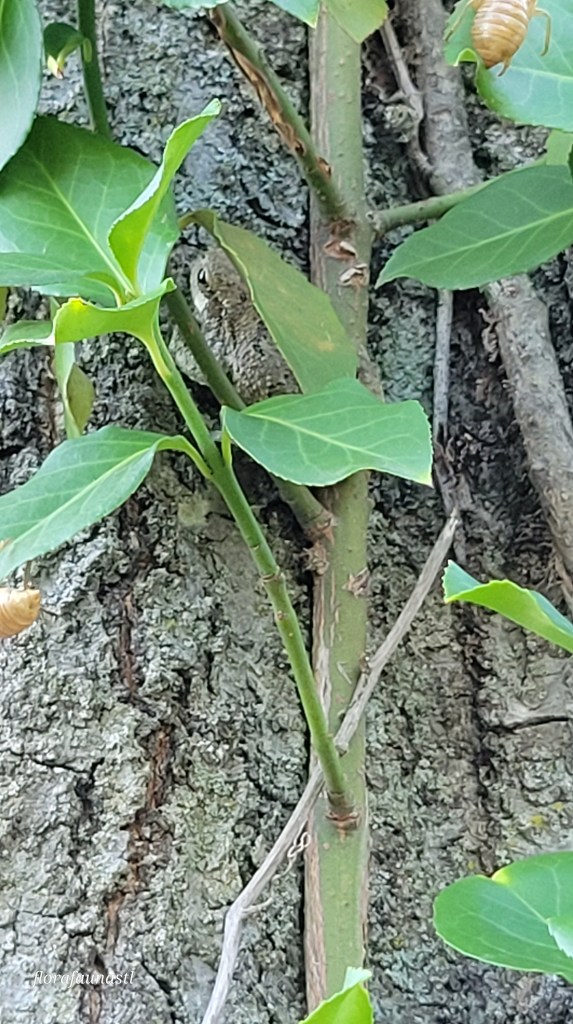

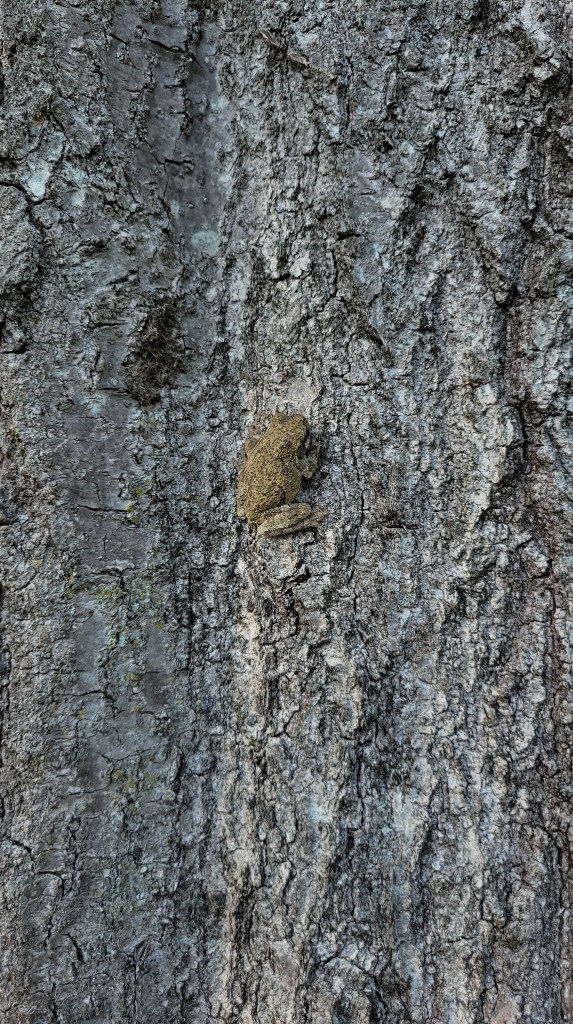

Morphologically speaking, both species of gray treefrogs are the same; however, Cope’s gray treefrog is usually smaller and has a larger population of green coloration than the eastern gray treefrog. Their body length ranges from 1 1/4 to 2 inches; this does not include extended legs. The gray treefrog can live for up to 9 years and they become sexually mature after about 2 years. Their mating season runs from April through August, and the males call for a mate through a rather high-pitched bird-like trill. The frequency of the trill or call is how to tell the two species apart, as their calls have different pulse rates per second. This is not always foolproof though, as the calls will sometimes fluctuate in pulse rates based on the temperature and may start to sound similar. Scientists will actually use recording equipment and analyze the calls in a laboratory to determine the species. While on the differentiation methods of the species, they also differ by the number of chromosomes. This gives you a good idea of how hard it is to accurately tell them apart for laymen, including yours truly.
The males will often sit near water when calling for a mate, as they must lay their eggs in water. Once a female has been wooed, the male will grab her tightly with his forelegs as they float in the water. The female will begin to lay eggs, and the male fertilizes them as she does so. Females can produce anywhere from 1000 to 3000 eggs per season. The eggs will hatch in about five days, and the tiny tadpoles will emerge. They will feast on small insect larvae and algae and will become froglets in about two months. Once they leave the water, they will spend the majority of their time hanging out on the ground near the waters from which they emerged.
Gray treefrogs survive the winter by burrowing into the ground. Their liver produces plasma glycerol, which is like antifreeze for their blood. This allows the gray treefrog to avoid freezing damage to their bodies during their dormancy in the winter months. Grey treefrogs that have been dug up during this dormancy have glossy opaque eyes and are stiff; they essentially look like frog corpses, but are in fact very much alive and just waiting for spring. Despite adding to the natural ambiance of summer, they also help to keep insect populations at bay. They dine on an array of insects, spiders, small snakes, and other frogs.
After getting some good videos and pictures for the site, we let the frog go near a tree in the backyard. The small forest that once extended over the pool has since been cut back, and the pool has been cleaned and is now fully functional. The Webbs have been swimming and enjoying their new home, but the gray treefrogs will have to find a new body of water to lay their eggs. We were recently at the Webbs’ house for a get-together, and judging by the many trills in the distance, it seems they have already discovered a body of water not too far off in the distance. Perhaps another neglected pool is being utilized and claimed by the gray treefrogs.

References:
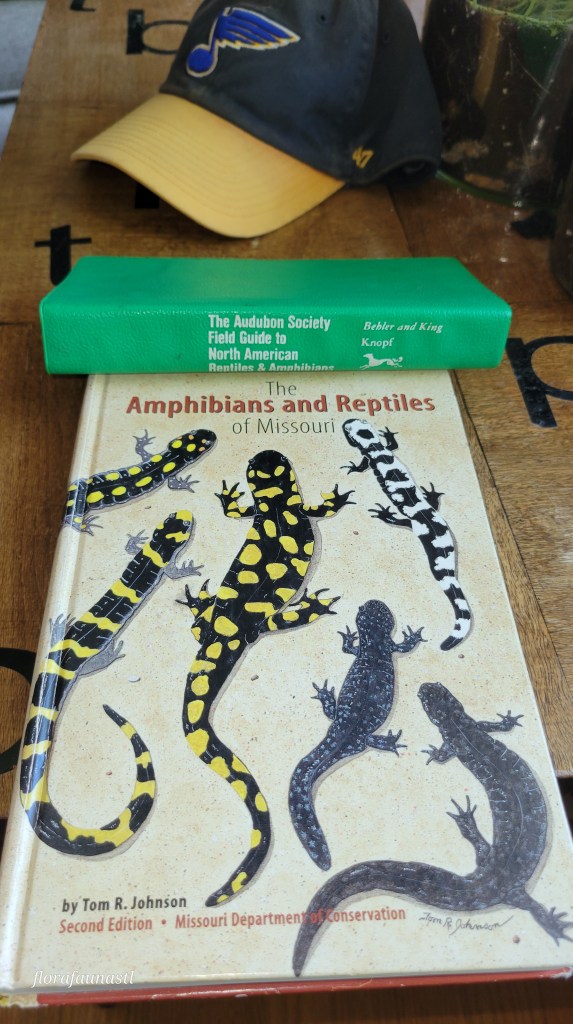
Behler, J. L. and King, F. W., (1979), The Audubon Society Field Guide to North American Reptiles and Amphibians, Alfred A. Knopf Inc., New York.
Johnson, R., Tom,(2000), The Amphibians and Reptiles of Missouri (2nd edition), Missouri Department of Conservation, Jefferson City, Missouri
https://mdc.mo.gov/discover-nature/field-guide/gray-treefrog-copes-gray-treefrog
 Flora Fauna STL
Leave a comment