
It was September 9th, 2020, and the world was in a state of lockdown. We were still getting acquainted with the lockdown protocols and anxious about the future state of the world. Covid had hit the scene and there were a lot of unknowns at the time about the virus. On this particular day, though, there was a different kind of unknown lurking around St. Louis, an unknown that made my wife and I, along with other park patrons, scratch our heads.
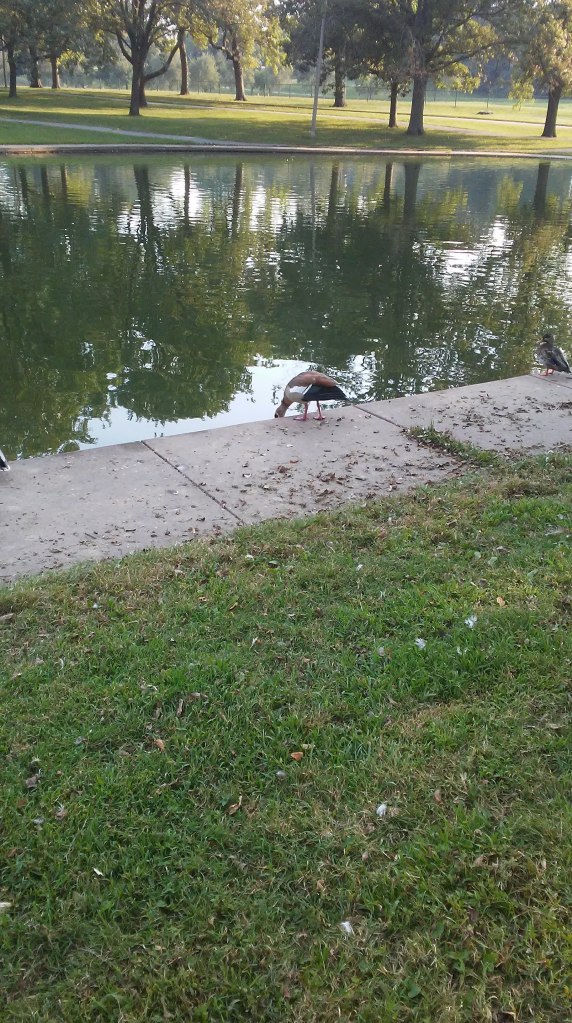
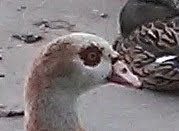
We were out for a stroll with our 9-month-old son when we noticed a duck that seemed out of place. At Willmore Park, the ducks are plentiful, and you will see Mallards, Swans, and Canadian Geese, but this was none of the above. To be blunt, it appeared to be the duck version of the harbinger of doom. It tried to play it off and act as though it was just part of the gang, but nobody was buying it, not even the other ducks.
As we got closer to photograph and film this strange bird, it chased off other ducks aggressively, with the exception of one large white duck it must have befriended. There was a small hook on the tip of its beak, and its quack was less duck-like and more of a raspy honk. I had never seen this creature before and have never seen one since. And that is probably due to the fact that this particular waterfowl is not native to Missouri, let alone North America.
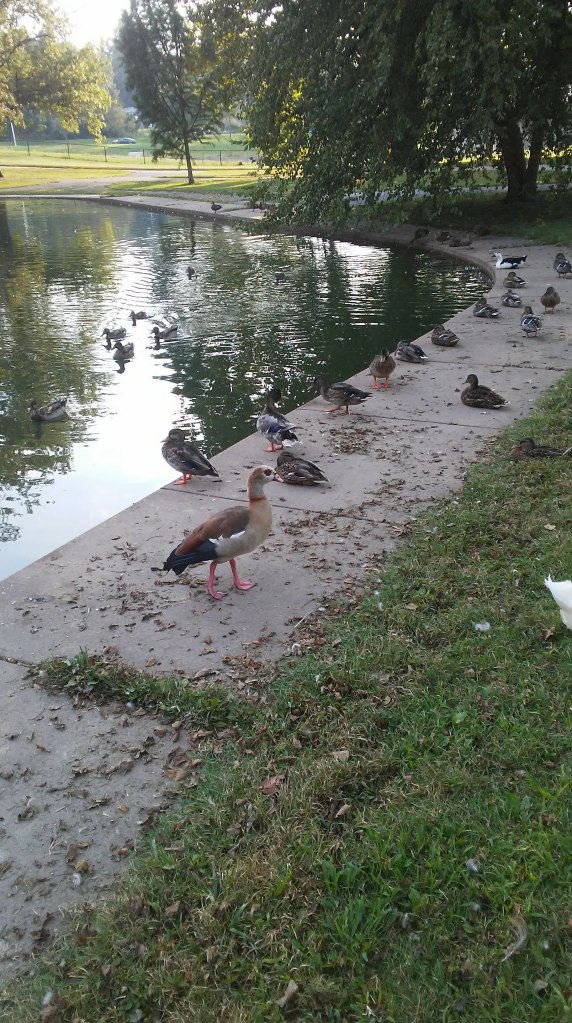
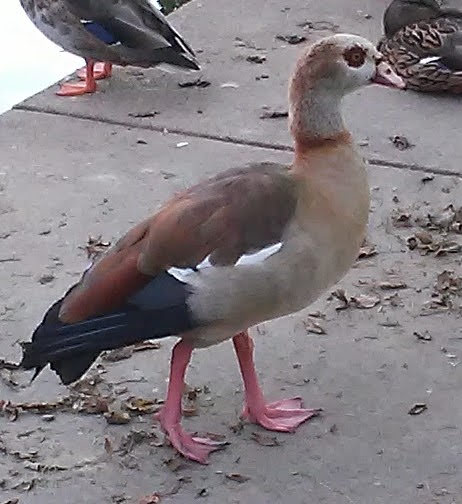
No, in fact, this bird is native to Sub-Saharan Africa and the Nile Valley. Its Latin name is Alopochen aegyptiaca, more commonly called an Egyptian Goose. This creature has a dashing set of feathers; contrasts of black, white, green, grey and tan, along with a pink bill and pink feet. Their eyes are encircled in a rustic red, and they are very captivating to the eye, especially when they are so out of place. Outside of size difference, males are slightly bigger, there is no substantial sexual dimorphisim or coloration differences between the sexes.
The ancient Egyptians considered these ducks (yes, they are closely related to shelducks and are not Geese at all) sacred, and they are abundant in their artwork and hieroglyphs. In its native lands of Africa, it is known to breed year-round but does have a peak breeding season during late spring. They are monogamous and typically pair for life, with both parents taking turns incubating and rearing the young.
They can be found in flocks when they are not nesting but are extremely territorial once the nest has been built, even going as far as killing each other’s young. They will also aggressively attack other birds mid-flight in a WW2 dogfighting fashion if they come close to their territory. Nests can be found in tree hollows or shallow holes in the ground. They are also fond of old raptor nests and do not always nest near water, as most waterfowl do.
Egyptian Geese usually lay between 5-10 eggs per season, and these take about 30 days to hatch. The young mainly feed on water invertebrates, while adults feast on grasses with the occasional insect thrown in.
Now I am sure you are wondering how this lone Egyptian Goose made it to St. Louis? Some say it heard about the T-Ravs and Gooey Butter Cake and decided a quick flight across the Atlantic was worth the good eats. The honest answer, though, lies more with an accidental introduction of a non-native species to the United States. Because of the beautiful and unique plumage of this bird, it was brought back to Britain in the 17th century and let loose in private estates and zoos.
As we see time and time again, a few escaped and established a breeding colony, and they can still be found in Britain today. This is the start of this trend, and the birds are now found in Australia, the Netherlands, New Zealand, the United Arab Emirates, and the United States. In the United States, they tend to be found in southern regions but will sometimes venture north. This stray Egyptian Goose most likely ended up here from the southern hemisphere of the United States, and I presume it made its way back after getting its T-Ravs.
As mentioned earlier, these guys are pretty aggressive, and as an invasive species, this can be problematic to native populations. They are known to drive away and destroy nests of native birds. They have even been observed strong-winging (technically, they don’t have arms) nests away from owls and ospreys. This can be detrimental to certain species who are already struggling in their fight against extinction.
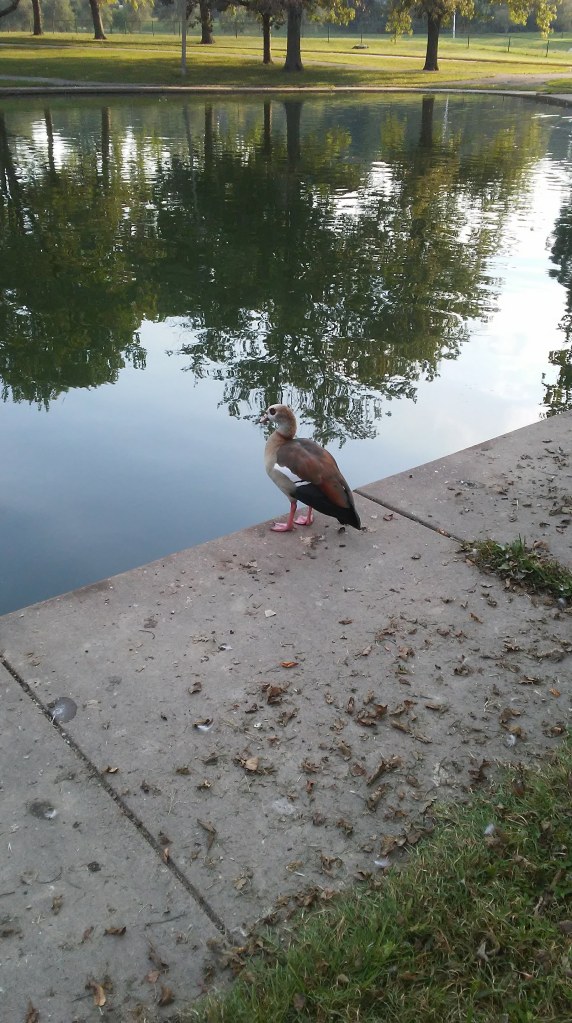
With that said, in Florida and other states, these are not a protected species and may be hunted year-round. Although this is not a native species, it was found here in St. Louis, and thus I figured it would make for at least a good documentation of its range within the United States. Although these birds are beautiful outside of their native range, they can pose problems as they have a rather nasty attitude towards others. When I asked this particular Egyptian Goose how it made its way here, it simply flipped me the bird, which fits the bill. I found this to be most fowl.
References:
https://www.oaklandzoo.org/animals/egyptian-goose
https://www.wildlifetrusts.org/wildlife-explorer/birds/waterfowl/egyptian-goose

 Flora Fauna STL
Leave a comment