
It was one of those gorgeous end-of-summer evenings: cooler weather and the crisp hint of fall in the air. We were heading to Rockwell Beer Garden in Francis Park to meet some friends. I was locking everything up and heading to the car. Judging by the look on my wife’s face, I should have been in the car at least five minutes ago. Despite this, my wife said to me, “Hey, do you want that grasshopper?!” pointing out of the window at the bookshelf we had set out for big trash pick up. As I went about capturing the grasshopper, my wife and kids watched on with slight amusement but mostly a lack of patience as they were ready to meet up with friends and have fun. I placed the grasshopper in its temporary home and we were off. After a night of fun and getting the kids to bed, my wife, being the wonderful hostess that she is, gave our tiny house guest spinach and carrots. That evening, I began thumbing through my books on insects, trying to learn more and figure out what type of grasshopper this was.
The next morning, the grasshopper looked somewhat shocked to see me approach its oversized glass jar as it casually ate some spinach. I took the lid off and reached in, and it casually crawled onto my hand. It had been a while since I had handled or came face to face with a grasshopper. My memory of grasshoppers is from when I would have been in kindergarten and living in Washington, Missouri. They were all over the place down there during summers. We would catch them, and their usual reaction would be to spit at us. Which, as children, we found disgustingly rad, and as an adult, it is still pretty cool. They do this as a defense mechanism and spit out partly digested food and stomach acid. This trick is fairly common in the animal kingdom and is known as “defensive regurgitation,” which would be a great name for a punk band. The hope is that whatever predator comes about will taste and smell this rancid juice and let the grasshopper live another day.
This grasshopper, which I identified as a Melanoplus differentialis or more commonly the Differential Grasshopper, was pretty mellow though and thankfully decided to keep its meal where it belongs. It was a little past 9:00am when I was identifying and photographing, and the temperature was around 65°F or so, and this is actually important. I had no idea how intertwined grasshoppers and the weather really are. I had a basic knowledge that certain weather conditions were more favorable and more prone to creating swarms of grasshoppers and potentially creating locusts, but I didn’t understand how mechanical their reactions are to temperature.
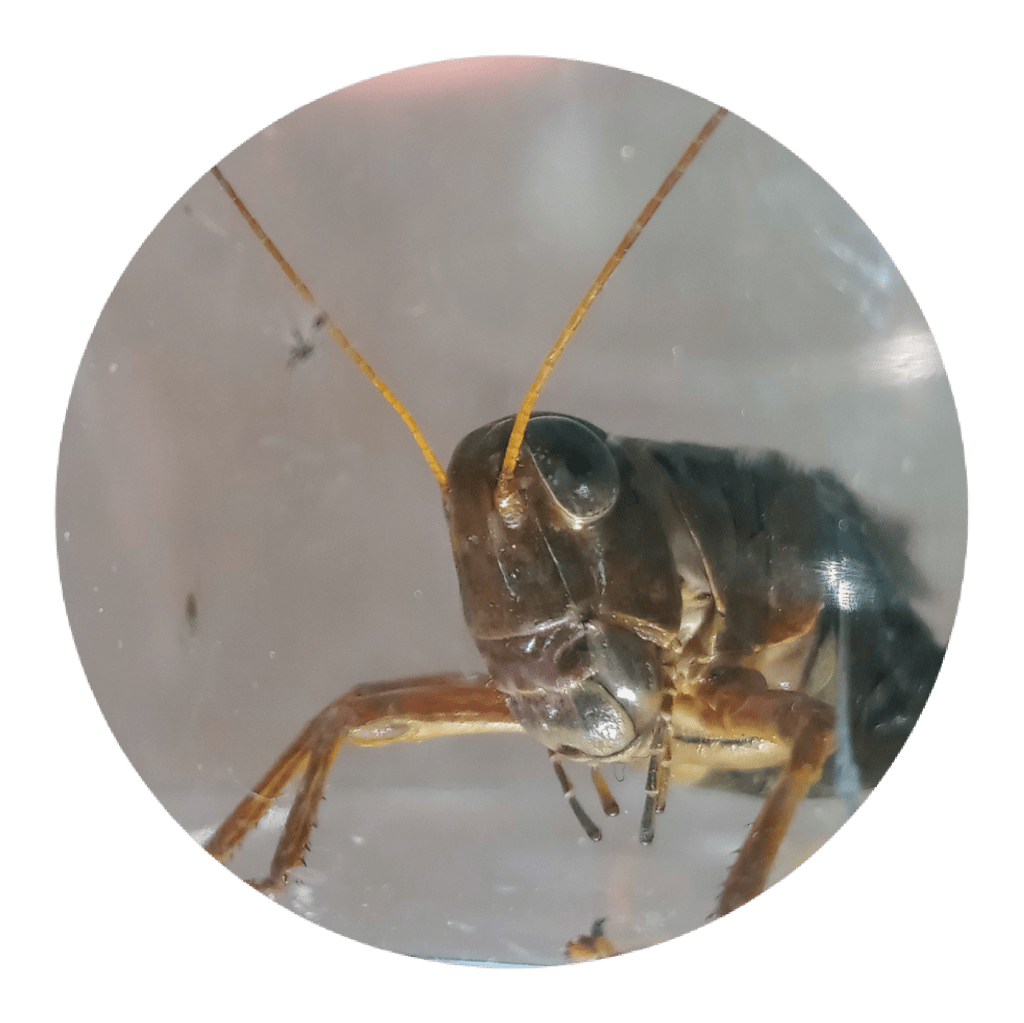
In hindsight, the reason this grasshopper was so calm had nothing to do with my son screaming “Look at his eyes!” or the breakfast spinach. This calm was simply its reaction to feeling non-threatened and, more so, the weather. You see, adult grasshoppers leave their overnight resting areas when temperatures are around 68°F or higher and head for their food sources. Once temperatures start to rise to 90°F and higher, they will look for shaded areas to avoid the sun, or they may take flight to avoid the hot surface temperatures. This relationship with the temperature doesn’t just happen in adults but dictates the entire lifecycle.
Females will wait for air temperatures around 70°F and deposit their eggs into the soil through a process known as oviposition. In layman’s terms, she sticks her ovipositor (behind) into soil in weedy areas near their food source. Mating occurs from late summer into fall, depending on temperatures, and females lay eggs after two weeks of preoviposition. Differential grasshoppers lay around eight egg clusters, each containing up to twenty-five eggs. The eggs are not very strong and can easily be destroyed by curious hands that pluck them from the soil. Farmers will often plow fields in late fall and early spring to try and reduce the number of grasshoppers eating their crops. These eggs start to develop in fall, but after reaching slightly over fifty percent of their development, they go into diapause. Think of diapause as a “suspended development”; they will stay in this phase until spring.
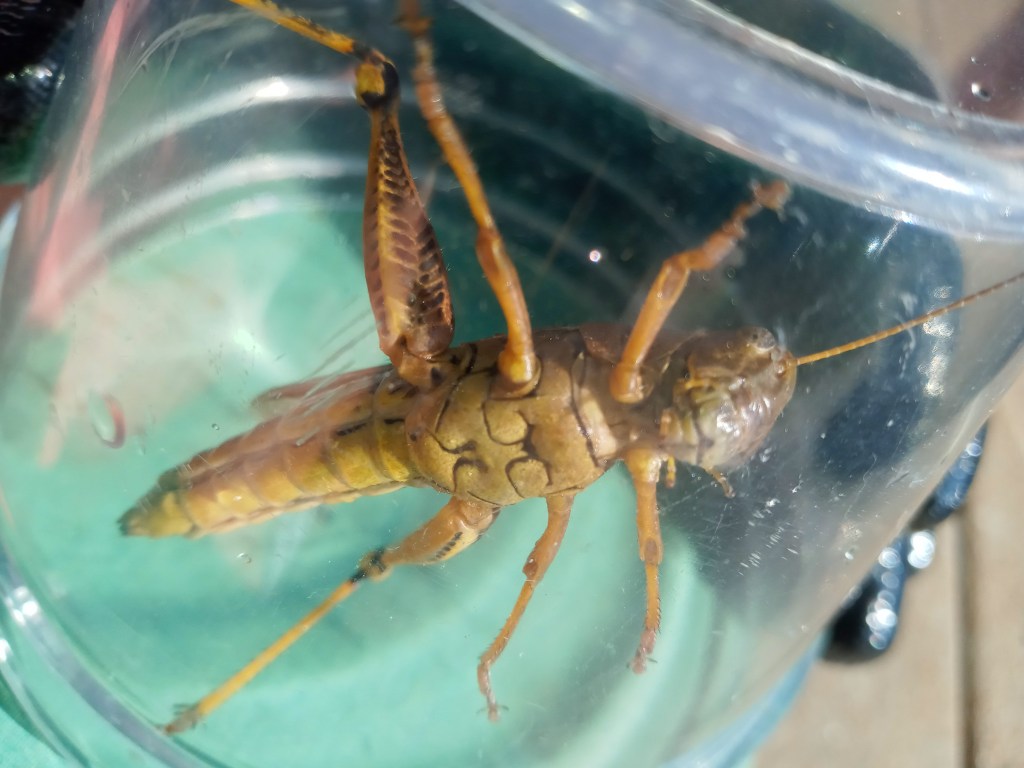
Now their kick-start to begin development again is controlled by… you guessed it, the weather. Once temperatures AND moisture levels become favorable, they will hatch. Depending on the year and weather patterns and rainfall, this could happen a couple of months early or late. At the time of hatching, they come out as nymphs and will go through five instars before reaching adulthood. An instar is the phase between molts. I can’t shake the image of grasshoppers having their life events being categorized by the periods of time between chocolate malts; the image of a grasshopper Fonz comes to mind. However, in this case, molting refers to the shedding and replacement of the exoskeleton. The nymphs will reach adulthood within a mere thirty-six days.
Because of the correlation between grasshoppers and the weather, the nymphs all emerge within two weeks of each other and begin eating. Differential grasshoppers will eat a wide variety of plants, but they do have some favorites: corn, wheat, soy, and deciduous fruit trees. There are normal checks and balances in nature, and the weather and predators of the differential grasshoppers tend to keep them at bay, but this is not always the case. The combination of warm fall weather followed by spring rains and hot summers has allowed for population explosions, as these are favorable conditions for these almost robotic insects.
In 1934, 1935, and 1936, the differential grasshoppers devastated crops in Missouri. The weather allowed for more of them to reach adulthood and they took advantage of this opportunity. The weather eventually became less favorable, and the mass destruction of crops came to an end. The destruction of crops was so bad that it would be compared to the Rocky Mountain Locust, although to be fair it was not nearly as massive a swarm nor destructive. It is because of this type of behavior that the majority of my research and source materials revolve around how to manage these “pests”. Which is fair considering the millions of dollars’ worth of damage these insects can cause annually.
They have learned to adapt to a wide array of environments, ranging from grasslands to urban settings, and are found throughout the majority of the United States, with the exception of the Northwest. With that in mind, it is easy to see they are vital to many ecosystems. They are key to many food chains and are on the menu for birds, raccoons, frogs, opossums, foxes, snakes, spiders, and many, many more species.
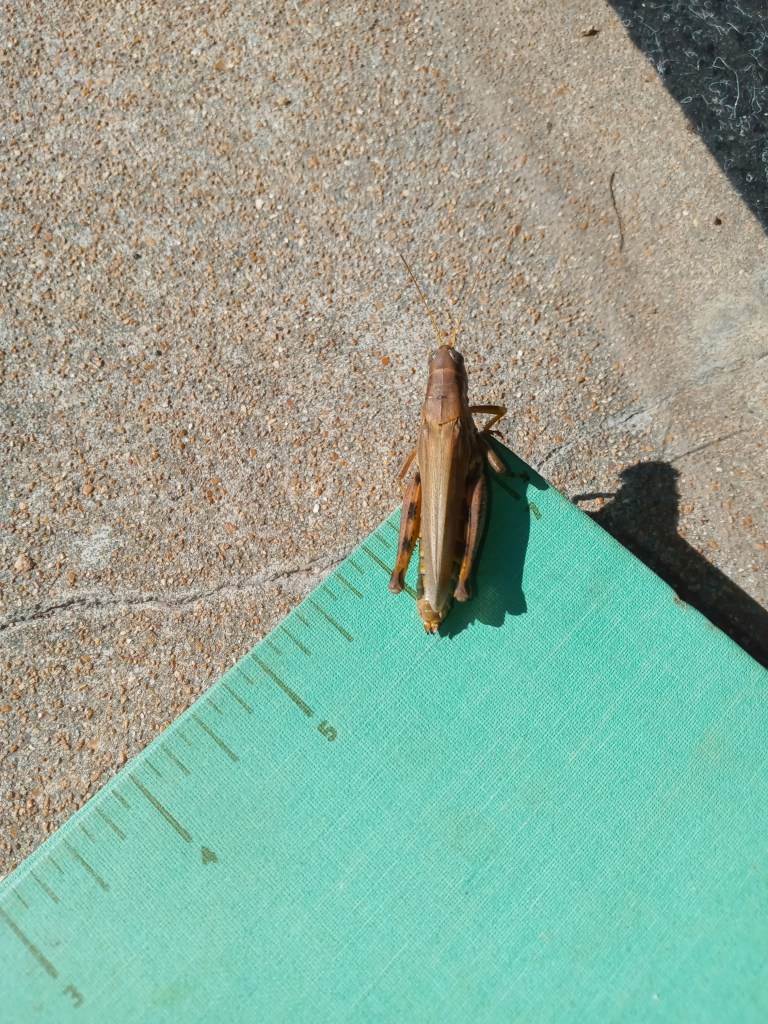
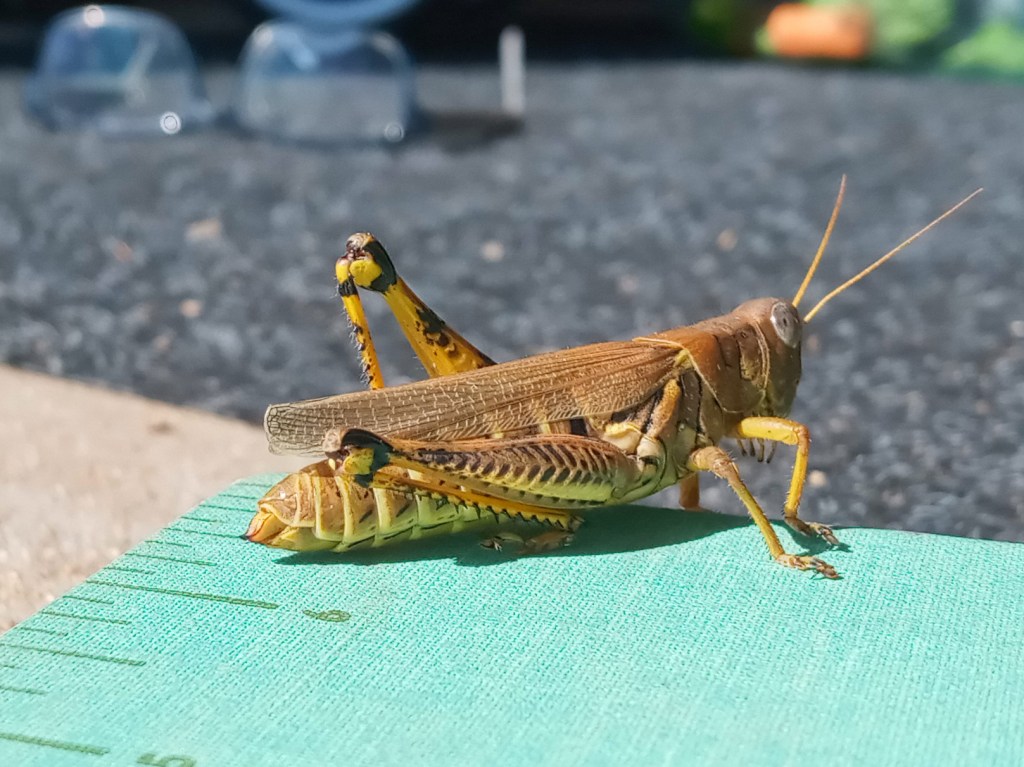
The identification of this species was not as difficult as I assumed it would be. They can reach two inches (our guest attempted to line up on the ruler, he was just shy of the two inch mark) and vary in coloration from brown to green, and occasionally, some are black. They have chevron patterns on their hind femur and don a pair of red antennae. They are short-horned grasshoppers, which means that their antennae are short compared to long-horned grasshoppers whose antennae are longer than the length of their bodies.
This has been by far the most time-intensive research I have done for any species, and some of the most fascinating. The differential grasshopper that we examined and housed for a day captivated all of us. We got to watch it eat a few plants in the yard and hang out with it for the majority of Sunday morning. It eventually flew off, and I haven’t seen it since. They produce one generation annually, and the adults do not overwinter, so his time is coming soon. It charmed everyone in the house and inadvertently taught me a lot. I hope he enjoys the last few weeks he has left and that he lead a very hoppy life.
References:

Milne, Lorus and Margery. (1980), The Audubon Society Field Guide to North American Insects and Spiders. Alfred A. Knopf, Inc., New York
Zim, H.S. and Cottam, C. (2001), Insects, St. Martin’s Press, New York
Borror, D. J. and White, R. E., (1970), Peterson Field Guides: Insects, Houghton Mifflin Company, Boston, New York
Pfadt, R. E., ( 1978), Fundamentals of Applied Entomology (3rd edition), Macmillan Publishing Co., INC., New York
https://mdc.mo.gov/discover-nature/field-guide/differential-grasshopper
https://www.uwyo.edu/entomology/grasshoppers/field-guide/medi.html

 Flora Fauna STL
Leave a comment