
Last Saturday night, my wife approached me holding the cat’s water dish with a look of disgust on her face. At the bottom of the water was a sprawled-out spider. Begrudgingly, she mumbled, “There is a dead spider in here… Do you want it for your microscope?” She knew without asking that this was going to be inspected and identified. The kids screamed with excitement when I replied, “Oh yes, I do!”, which is a dead giveaway they are being raised right. I grabbed my tweezers and fished out a small grey and red spider from the bottom of my cat’s water dish. Who knows how long it had been there. Its limp body moved at the bottom of the dish with the slightest movement as I carried it to the microscope.
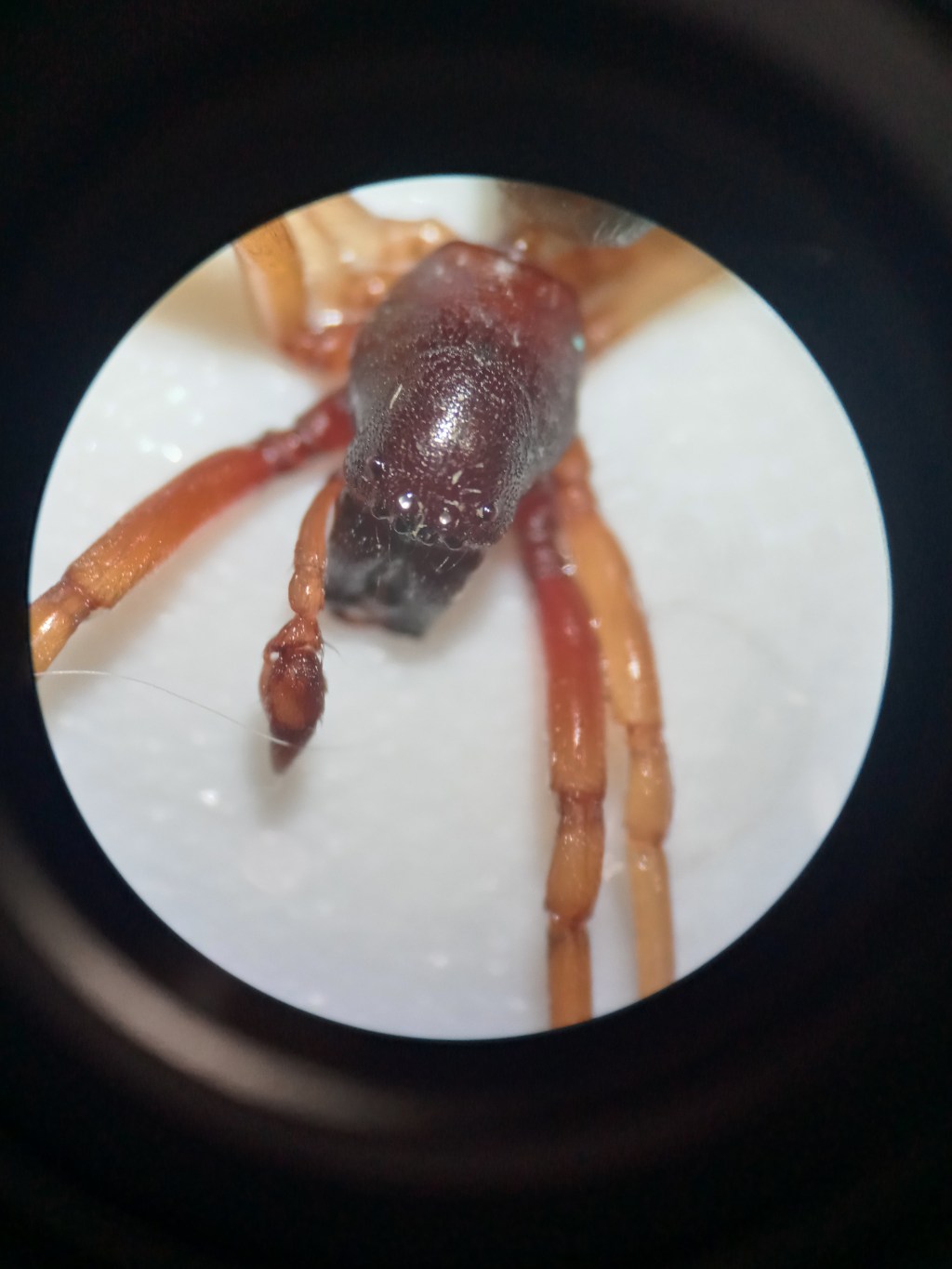
With its legs all spread out, I could see two things right away: it was missing a pedipalp, and it was male, judging by the size of the remaining pedipalp. For learning purposes, the pedipalps are the leglike structures between a spider’s front legs and jaws. They are smaller on females and enlarged on mature males. Pedipalps have many uses, such as holding food, serving as sex organs, and facilitating communication. In terms of mating, males place their sperm on the pedipalp, and the sperm is ultimately deposited or transferred to females via their reproductive organs.
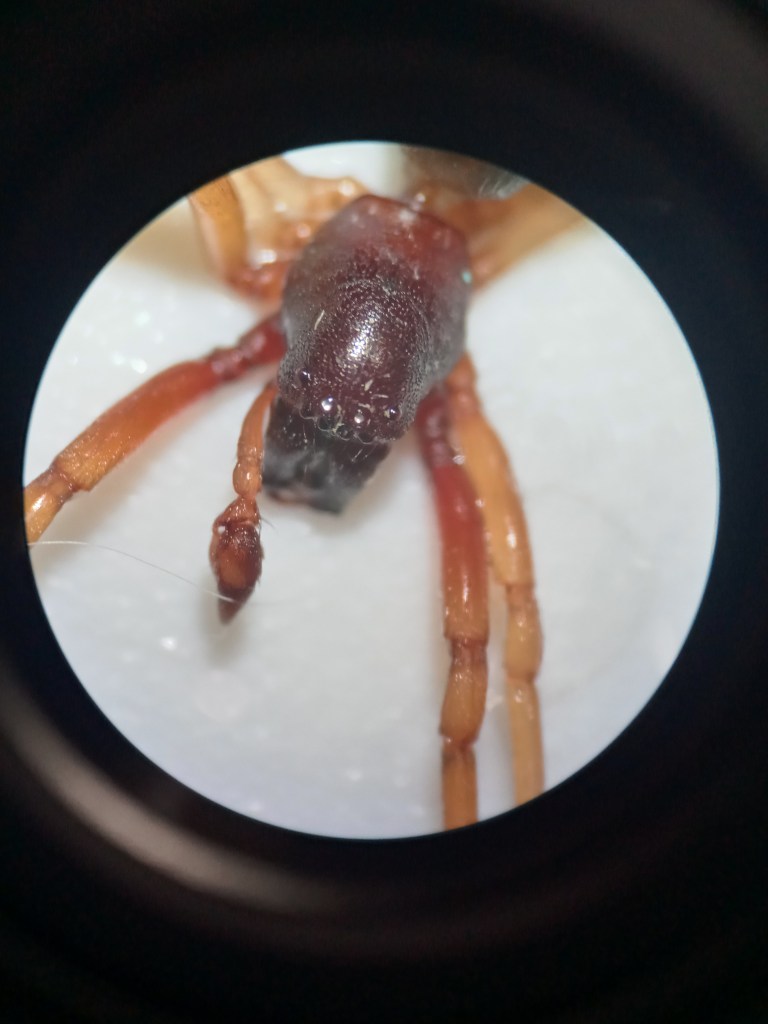
Back to the story, with the spider in place and children pushing for a glimpse of this unfortunate soul, I adjusted my microscope to get a better look. He was positioned on his belly so we could see his face. My daughter exclaimed, “That is a lot of eyes… Woah, look at his teeth!” My son pushed his way in and shrieked, “It’s scary!” before fleeing the scene. The kids quickly lost interest, and I got to work identifying this species. The orangish-red legs naturally extended forward, and it had eight eyes in two rows, with four eyes in each row. The abdomen was grayish with no identifying marks. Using my tweezers, I turned him over and investigated the underside, looking for any other markings or clues to help me identify him.
While on his back, I saw that he had a very large set of reddish-brown chelicerae (fangs). I headed to the den to grab a few books to start working on identification. As I thumbed through the first two books, I read a description and then glanced over at this limp, small but intimidating-looking spider, trying to find a match. I flipped him back onto his stomach and began to push with my tweezers on the carapace (the shell covering the cephalothorax, which some might refer to as the head), trying to get a better look at his face from a top-down view.
As I was looking at this spider under the microscope at 400x, its front legs sprung to life and jetted up. I jumped back in shock, thinking it was just postmortem spasm. I was quickly proven wrong when the spider started making a dash for it! At that moment, I felt as though I was in a 1950s B-movie meets a Mary Shelley novel. With little time to react, I quickly grabbed a jar. He ran right in, as I am sure he was tired of the spotlight, or microscope spotlight, that is. I must have inadvertently resuscitated him with the poking from my tweezers.
For the next twenty minutes, I watched as he cleaned every leg and started establishing web trails on the jar and stick that I added for his comfort. His emotionless eyes glaring up at me as he explored the enclosure told me that he had now seen things no other spider ever had. I wondered if spiders go towards the light or towards the darkness when making the journey to the afterlife. I did ask what he saw, but he showed little to no interest in the conversation.
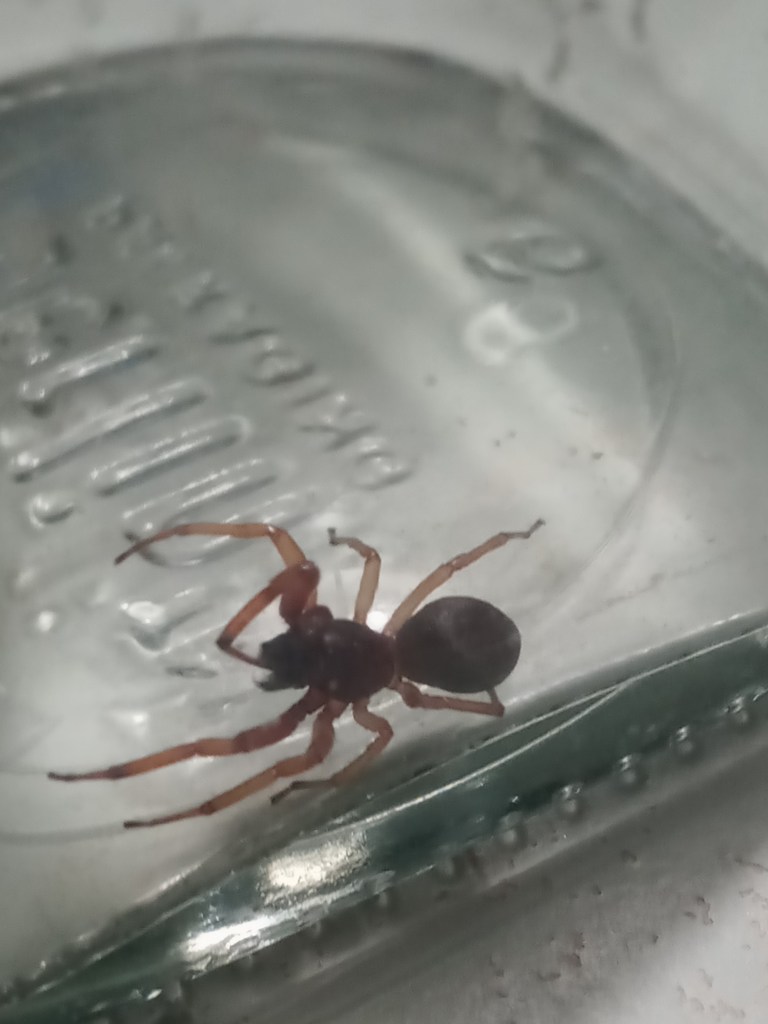
At last, I was able to identify him as a Trachelas tranquillus, or more commonly, a Broad-faced Sac Spider. They range throughout most of the United States, as well as Canada. They are active hunters, meaning they do not lay and wait for bugs to become ensnared in a web. Instead, they lay in wait and ambush or chase down unsuspecting victims. They do, however, build a web sac that they will lay in wait in, under foliage or other conveniently hidden places. They will also lay their eggs in these sacs during autumn months.
Now I am sure most of you want to know if this spider is dangerous. The short answer is no, unless you have an allergic reaction to insect bites. That being said, the spider is known to scavenge on dead insects, including other spiders, which can lead to its bites causing a secondary infection. These spiders are not very aggressive, though, and are more likely to flee than attack. I will never know how he ended up in the bottom of the cat’s watering dish or what went through his mind as he realized this is the end. Nor will I ever know if he understood the gravity of the situation he was in and that he was ultimately saved to hunt another day.
I do know, however, that he did outlast me in all three of the staring contests that we had that evening. He was released back into the front yard and without haste made a dash for the grass. I am sure he had a lot to process. I reached out to Animal Planet and pitched “Spider 911,” but they stated the show had no legs to stand on. I rebutted with, “Well, actually it has at least eight…unless a patient has lost a limb!” The phone line went silent, and that was the end of my Hollywood dream. Well, there you have it, my fellow St. Louisans. The first of many spiders has been documented and identified… and brought back from the beyond.

References:
Milne, Lorus and Margery. (1980), The Audubon Society Field Guide to North American Insects and Spiders. Alfred A. Knopf, Inc., New York
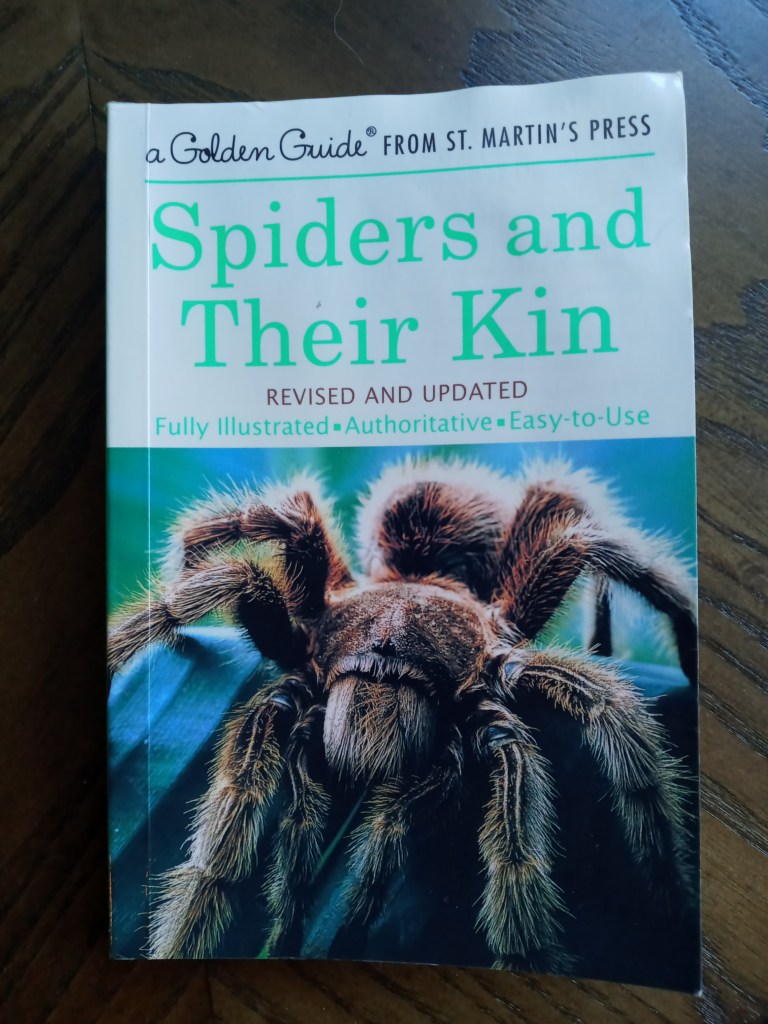
Levi, Herbert W. and Lorena R. (2002), Spiders and Their Kin, St. Martin’s Press, New York


 Flora Fauna STL
Leave a comment